



Operations
Laundry KPIs for sales managers: what each customer holds, loses and costs
Sales manager KPIs in short
A sales manager in a laundry needs figures that hold up in front of a customer: what the customer received, what came back, what is missing and what the contract really costs to serve. The KPIs that matter most are the customer balance, the loss rate per customer and the losses that can be charged under the contract, textile cost per customer, stock against the agreed par level and delivery accuracy. They decide whether a contract renewal starts from facts or from a discussion about numbers.
This article is part of our series on laundry KPIs by role. The definitions are the same in every article, so the figure in a customer meeting is the figure operations and customer success work with.
What the sales manager needs to know
- What does each customer hold today, per item type?
- How much does each customer lose, and what can be charged for under the contract?
- Which contracts carry their textile cost, and which do not?
- Which figures can I show the customer without a dispute about the count?
KPIs for the sales manager
| KPI | Definition | How to measure | Why it matters |
|---|---|---|---|
| Customer balance | What a customer has received, returned and still holds, per item type. | Dispatch reads and return reads per customer and period. | The basis for every customer conversation and for contract renewals. |
| Loss rate per customer | Items delivered to a customer and not returned within the agreed return period, as a share of the items delivered. | Dispatch reads compared with return reads at the customer site and intake reads for the same items. | Shows which customers cause which losses. |
| Chargeable losses per customer | Items lost at a customer that can be charged under the contract, with their agreed replacement value. | Losses per customer, linked to item type and the value agreed in the contract. | Turns a loss discussion into a list both sides can check item by item. |
| Textile cost per customer | Replacement and repair cost caused by a customer, compared with what the contract covers. | Losses, repairs and retirements per customer, linked to item values. | Shows which contracts carry their textile cost and which do not. |
| Stock against par level | Items a customer holds per item type, compared with the quantity agreed in the contract (the par level). | Customer balance per item type, compared with the contract. | Surplus stock at a customer is textile capital that is not paid for. |
| Delivery accuracy | Share of deliveries in which the quantity per item type matches the order or the par level. | The dispatch read per cart or bag, compared with the order. | A documented record of service quality for renewals and new customers. |
Loss charges work best when the customer can see the same list. Our guide on linen loss explains how losses arise at the customer site and how to measure them.
How to calculate the core KPIs
Sales KPIs are calculated per customer and item type, with the return period and values agreed in the contract.
- Customer balance = items delivered − items returned, per item type
- Loss rate per customer (%) = items not returned within the agreed return period ÷ items delivered × 100
- Chargeable losses = items not returned within the return period × the replacement value agreed in the contract
- Stock against par level = customer balance − linen par level, per item type (positive means surplus, negative means shortage)
- Delivery accuracy (%) = deliveries matching the order per item type ÷ all deliveries × 100
Which of these KPIs need item-level data
| KPI | Without item-level data | With item-level data (RFID) |
|---|---|---|
| Customer balance | From delivery notes and counts by hand. | From dispatch and return reads per item type. |
| Loss rate per customer | Only as a total at the stocktake, rarely per customer. | Per customer and per item, with the last read. |
| Chargeable losses per customer | An estimate the customer can dispute. | A list of items with their dispatch read and no read since. |
| Textile cost per customer | Allocated by share of volume. | From losses, repairs and retirements per customer. |
| Stock against par level | From delivery notes. | From the customer balance per item type. |
| Delivery accuracy | From packing lists and checks by hand. | From the dispatch read per cart or bag. |
How sales managers work with these KPIs
- Bring the customer balance to every customer meeting, per item type and period.
- Agree return periods and loss terms in the contract in a form that can be measured, for example per item type.
- Review textile cost per customer before each renewal, together with purchasing.
- Show new customers a delivery record instead of a promise. In uniform programs this goes down to the wearer, as our guide on RFID in uniform rental programs shows.
From reads to figures
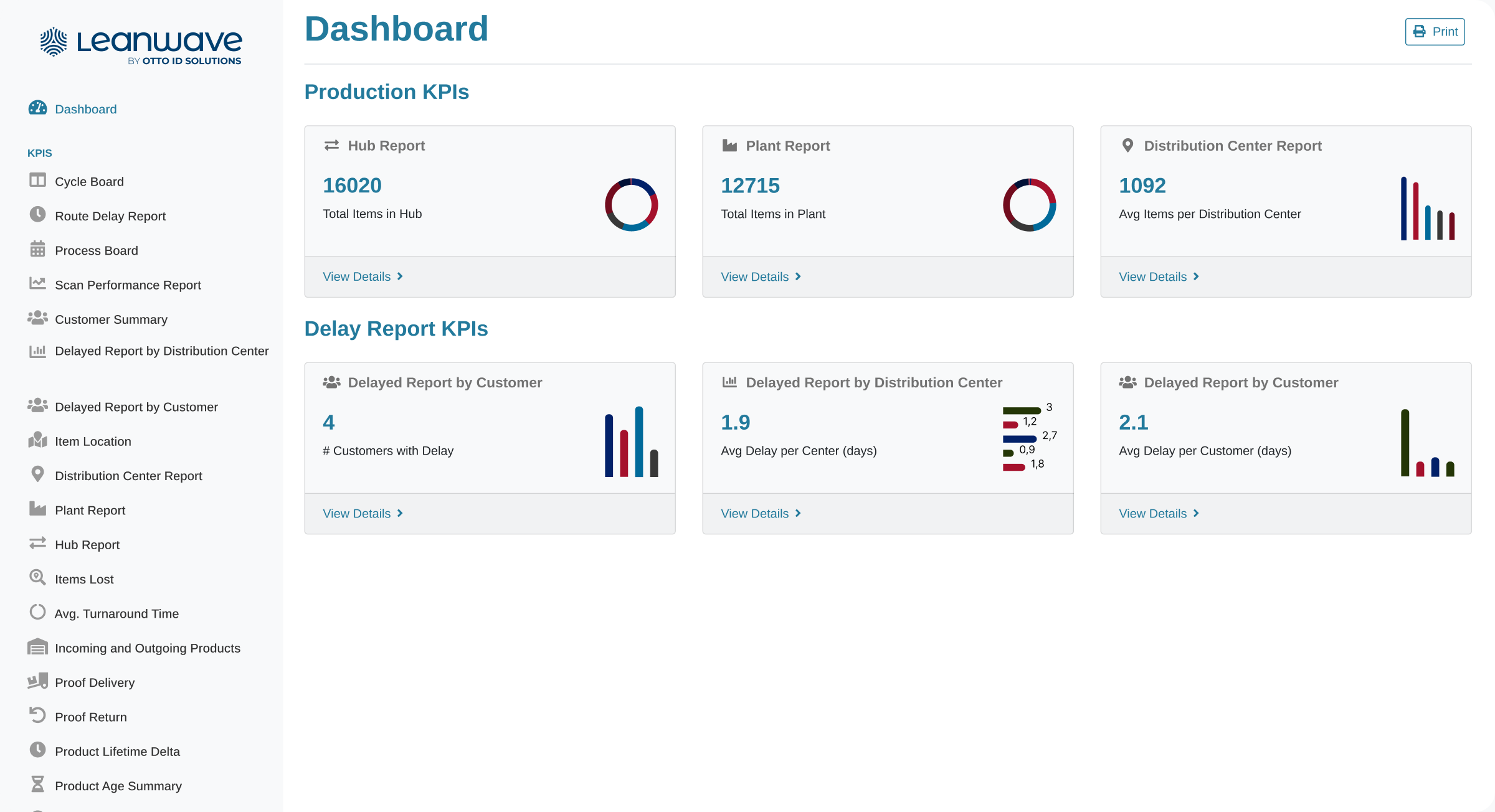
In the Leanwave dashboard, sales and customer success see a customer summary with balances and delivery records, so a conversation with a customer starts from the same figures on both sides. Finance and controlling see losses and circulation per customer and per site. Our page on textile tracking software shows the views for each team.
KPIs for the other roles
Every role looks at the same textiles and the same reads, with the same definitions. All KPIs with formulas are in our overview of laundry KPIs. The other articles in this series cover:
- Operations manager: losses, circulation and stock along the whole cycle.
- Laundry manager: productivity, quality and throughput in the plant.
- Process manager: where items wait, fail or go missing between stations.
- Purchasing manager: wash cycles, product lifetime and replacement.
- Customer success manager: deliveries, balances and complaints.
FAQ
 FAQ
Questions about
sales KPIs
Which KPIs should a laundry sales manager track?
Customer balance, loss rate per customer, chargeable losses under the contract, textile cost per customer, stock against the par level and delivery accuracy. They show what each customer holds, loses and costs, in figures that both sides can check.
What is a customer balance in a laundry?
The customer balance shows what a customer has received, what has come back and what the customer still holds, per item type and period. With RFID it comes from the dispatch reads and the return reads, item by item, instead of from delivery notes.
How can a laundry charge customers for lost textiles?
The contract sets the return period and the replacement value per item type. Items that were delivered and not returned within that period are listed with their dispatch read and their last read. With item-level data, both sides can check the list item by item.
What is a linen par level?
The linen par level is the quantity of each item type a customer should hold according to the contract, for example a set number of towels or garments per wearer. Comparing the customer balance with the par level shows shortages and surplus.
Explore
More on RFID for laundries
Take the full system, or only the part you are missing. These pages go into each part and each industry.
- RFID laundry trackingHow tags, readers and software follow every textile through the laundry cycle, step by step.

- RFID laundry management systemDashboard, stock per customer, roles and integration: the software side of RFID in the laundry.
- RFID laundry tagsSaphire One: designed for 200 industrial wash cycles, sterilisation at 134 °C, sew-in or heat-seal.
- RFID linen trackingSheets, towels and table linen counted in bulk, with balances per customer for linen rental.
- Textile tracking softwareUse our software with tags and readers you already have, or as part of the full system.
- RFID for workwear and uniformsEvery garment linked to a wearer and a customer site, for uniform and workwear rental.
- RFID for healthcare laundriesHospital linen management with RFID: linen, scrubs and patient gowns per ward and hospital.
- Hotel linen trackingFor laundries serving hotels: see per property whether the planned stock of sheets and towels per room (the par level) is really there, with rental and hotel-owned linen kept apart.
- IndustriesWorkwear and uniform rental, healthcare, hospitality and linen rental: RFID by industry.
Blog
Related Blog
Operations
Laundry KPIs for customer success managers: deliveries, balances and complaints
The KPIs a customer success manager in a laundry needs to see a problem before the customer calls: delivery accuracy, on-time delivery, stock against par level, items not yet returned, complaints per customer and time to resolve them.

Operations
Laundry KPIs for purchasing managers: wash cycles, lifetime and replacement
The KPIs a purchasing manager needs to buy textiles on evidence: wash cycles per item, product lifetime, replacement and repair rates, items near the end of their life and stock in circulation against what contracts need.
Insights
Linen loss and linen inventory: where textiles disappear and how to measure it
Where sheets, towels and garments leave the cycle, from the laundry floor to the customer site, how to measure linen loss without a full stocktake, and which measures actually reduce it.