


Technology
RFID vs. barcode vs. camera in commercial laundries
The quick answer
RFID, barcode and camera systems do different jobs in a commercial laundry. This guide is about UHF RFID, the type used for laundry tags. UHF RFID identifies each item by a radio tag and reads many items at once without line of sight, so it counts whole carts at intake and dispatch. A barcode also identifies each item, but only when a scanner can see the code, one item at a time. A camera with AI recognises what an item is and what condition it is in, but not the exact identity of the item.
So the question is not which technology is best, but which one fits each step of your process. Our position is simple: if RFID is the answer, we build with RFID. If it isn't, we find what is. Sometimes that is a barcode, sometimes a camera, sometimes a change in the routine, and often a combination.
How each option identifies a textile
RFID
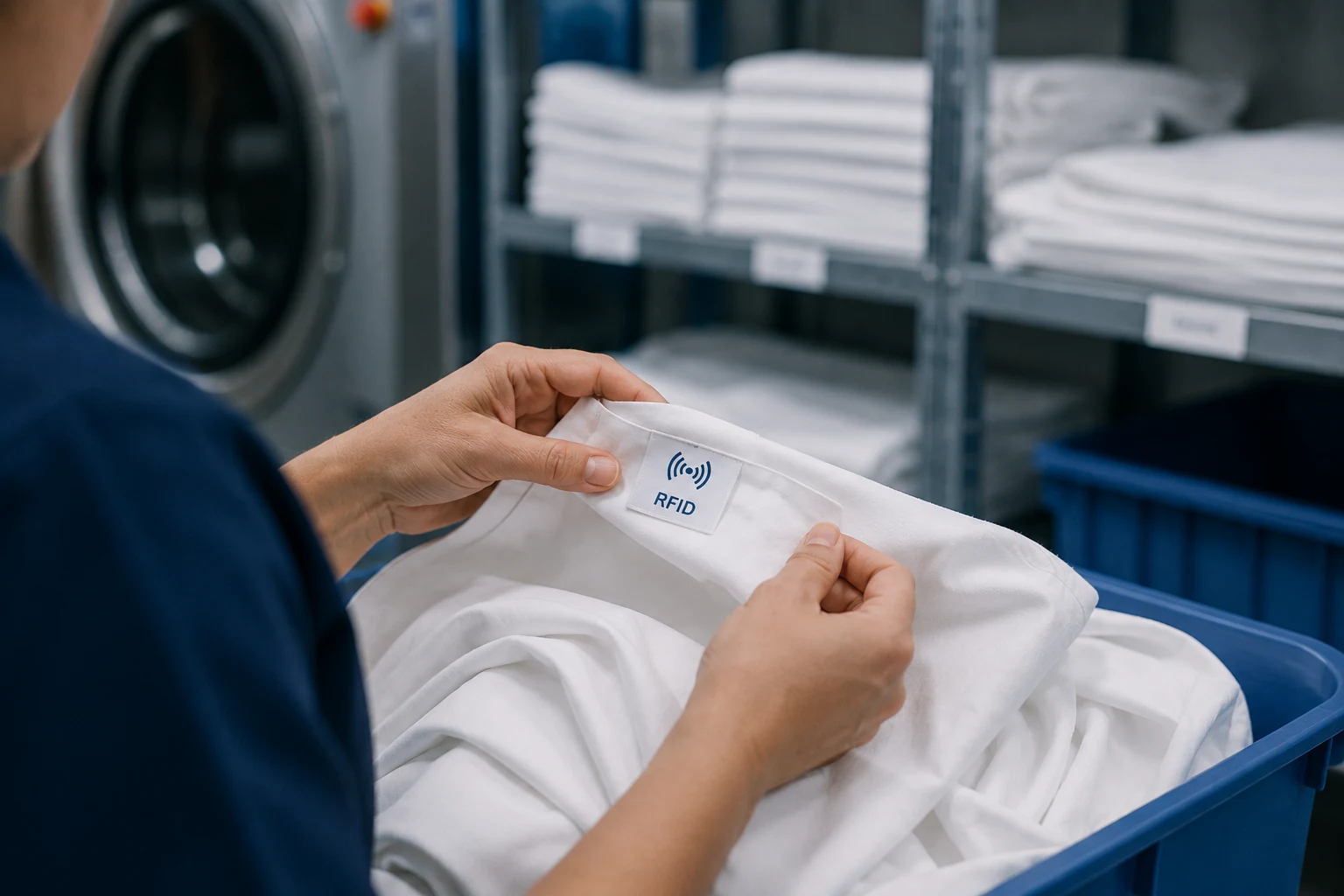
Each textile carries a washable, passive UHF tag with its own ID. The tag has no battery; a reader powers it with a radio signal and the tag answers. Laundry tags work in the UHF band, Saphire One from 860 to 928 MHz, and they can be read in bulk and through fabric and bags without being visible. Saphire One reaches a read range of up to 12 m, based on EECC free-air testing under FCC conditions. Actual read range depends on reader setup, tag orientation, textile arrangement and operating environment.
Barcode
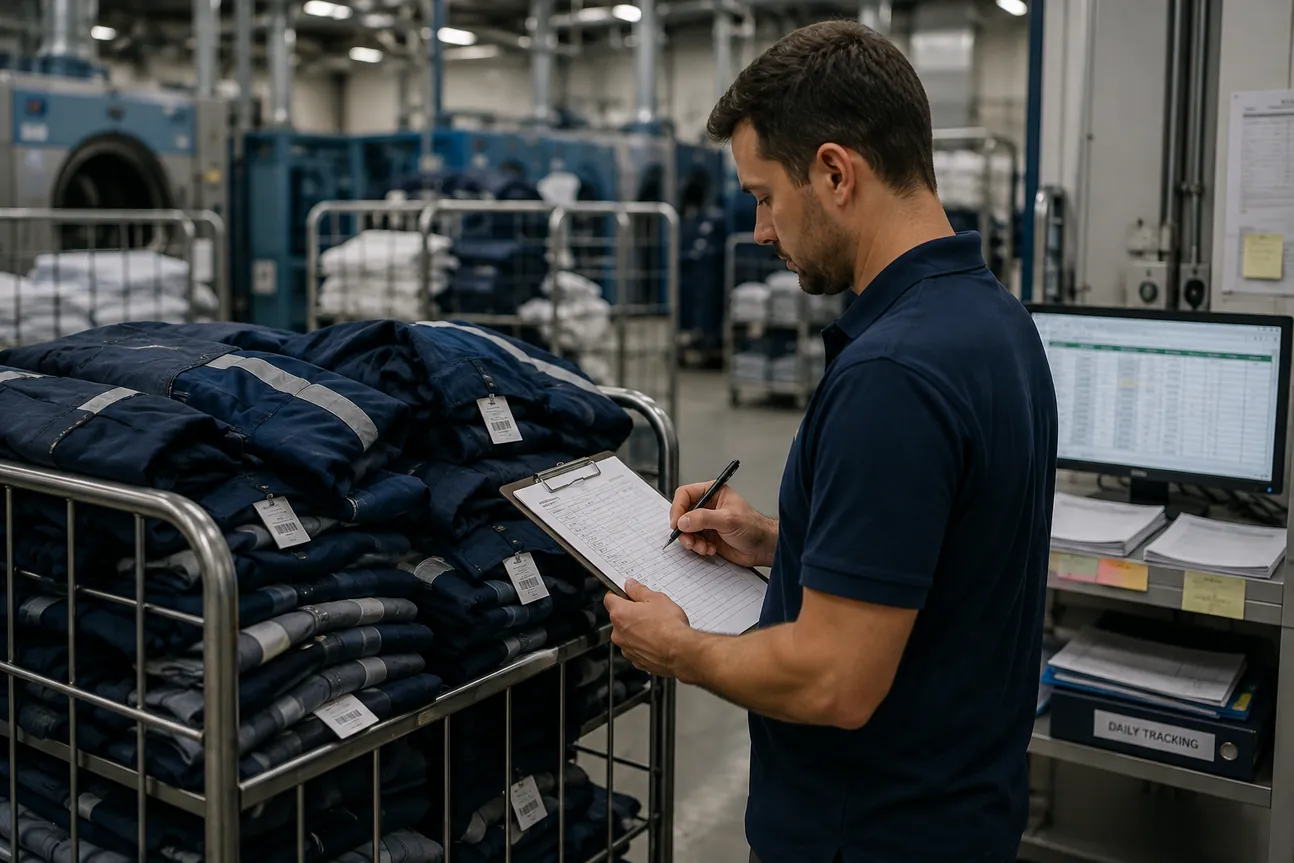
Each textile carries a printed code, usually on a label that is sewn on or heat-applied. A scanner reads it when it has a clear line of sight, one code at a time. The code has to stay readable through industrial washing, drying and finishing, and someone or something has to present each item to the scanner.
Camera and AI
A camera at a fixed position takes images of items as they pass, and software trained on such images recognises the item type and visible features such as stains, holes or faded colour. It needs no tag on the item, but it needs controlled lighting and a fixed position, and it tells you what an item is like, not which item it is.
Process change
Not every problem needs an identifier. If losses or delays come from the workflow itself, such as an unclear handover or a step where nobody counts, a changed routine can fix it without any hardware. It depends on people following it and produces no item history.
The decision matrix
The matrix compares the four options on the criteria that usually decide the choice in a laundry. It is the same assessment we use on our solution pages.
| Criterion | RFID | Barcode | Camera and AI | Process change |
|---|---|---|---|---|
| Identifies | Each individual item | Each individual item | Item type and visible condition | Nothing; it changes how the work is done |
| How it reads | Many items at once, without line of sight | One item at a time, with line of sight | Items passing a fixed camera position | Not applicable |
| Handling at the read point | None; carts and bags pass through | Each item presented to a scanner | Items passed or laid out in view | Depends on the routine |
| Item history | Yes: location, customer, wash count, last read | Yes, for every scan | No identity across cycles | No |
| Fits when | Volumes are high, items circulate many times and you need counts and histories per item and per customer | Volumes are lower and items are handled one by one anyway | What matters is visible, such as whether an item is clean, stained or damaged, or what type it is | Losses or delays come from the workflow itself, such as unclear handovers, a step where nobody counts, or a bottleneck |
| Limits | Every item needs a tag and every read point needs hardware; metal-heavy areas need a carefully planned reading zone | Needs line of sight and reads one item at a time, which is more labour-intensive; printed codes have to stay readable through industrial washing | Recognises a type or condition, not one particular item; needs fixed positions and controlled lighting | Depends on routines being followed; produces no item history |
| Typical use | Intake and dispatch counts, rental balances, wash counts | Manual check stations, small textile pools | Telling whether a garment is broken, stained or has lost colour, which also helps with sorting | A fixed handover routine, a reorganised dispatch area, a counting step where none exists |
Read the matrix by process step, not as a ranking. A laundry can reach a different answer at intake than at the quality check.
Where RFID earns its place
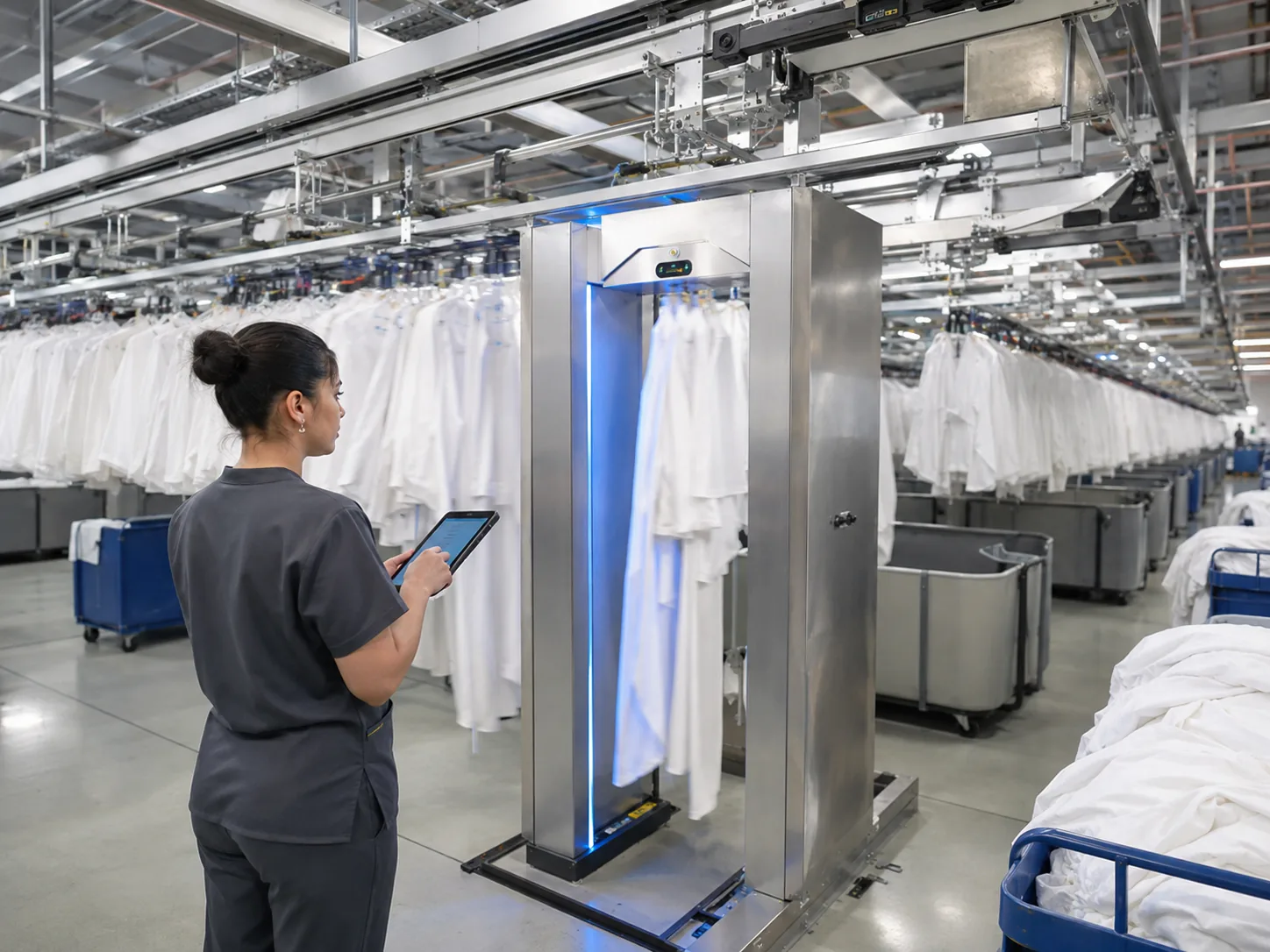
RFID pays off where counting is the bottleneck. A cart of soiled linen at intake or a cage of clean workwear at dispatch holds far more items than anyone wants to scan one by one. A tunnel or portal reads the whole load in one pass and books it to the customer, so differences against the delivery note show up at the dock rather than at invoicing. Tunnels and portals do the same job: a tunnel is cheaper and faster, a portal costs more but encloses the load and reads more accurately.
It also pays off where items circulate many times and their history matters: rental balances per customer, wash counts per item, what has left dispatch and has not come back yet, and replacement planning based on actual use. Every pass through a read point adds to the record without anyone touching the item.
The conditions have to fit. Tags have to survive your process; Saphire One is designed for 200 industrial wash cycles, 60 bar in the extraction press and sterilisation at 134 °C. Read points have to be planned for metal, water and dense loads. And volumes and losses have to justify a tag in every item and hardware at every read point. Our page on RFID laundry tracking shows the read points step by step.
When a barcode is enough
There are honest cases where a barcode is the better choice, and we would rather tell you than sell you hardware you do not need.
- Low volumes. If you process a small textile pool, the time saved by bulk reading is small, and the investment in tags and read points is hard to recover.
- Items handled one by one anyway. If each garment is already picked up, checked and hung individually at a station, scanning a code at that moment adds little effort, and bulk reading adds little benefit.
- Item inspection. When a single garment is inspected, for example for a repair, a barcode identifies the exact piece. Finding an item is easier with RFID: the reader looks for that one tag and shows which batch the item is in, and the barcode then identifies the piece within the batch.
- A barcode process that works. If your current system is reliable and losses are under control, replacing it is a cost without a clear return.
A barcode has its own conditions, though. The code has to stay readable through industrial washing, drying and ironing, and every scan needs someone or something to present the item. When volumes grow, or counting at intake and dispatch becomes the bottleneck, that effort is what tips the balance towards RFID.
We have written about this in more detail in our article When RFID Isn't the Right Answer, which describes the situations in which we advise laundries against RFID.
What cameras and AI do differently
A camera answers a different question. RFID and barcode tell you which item you are holding. A camera tells you what it looks like: whether it is stained, torn or faded, and what type of item it is. That makes it useful at the quality check, where a tag cannot help, because a tag says nothing about whether a garment is clean.
The limits are just as clear. A camera does not follow one particular item across many cycles, so on its own it produces no item history. It needs fixed positions and controlled lighting, and items have to pass in view.
Combined with RFID at the same station, the two complement each other: the tag says which item it is, the camera says what condition it is in, and the software records both against the same item.
Combining options along the laundry cycle
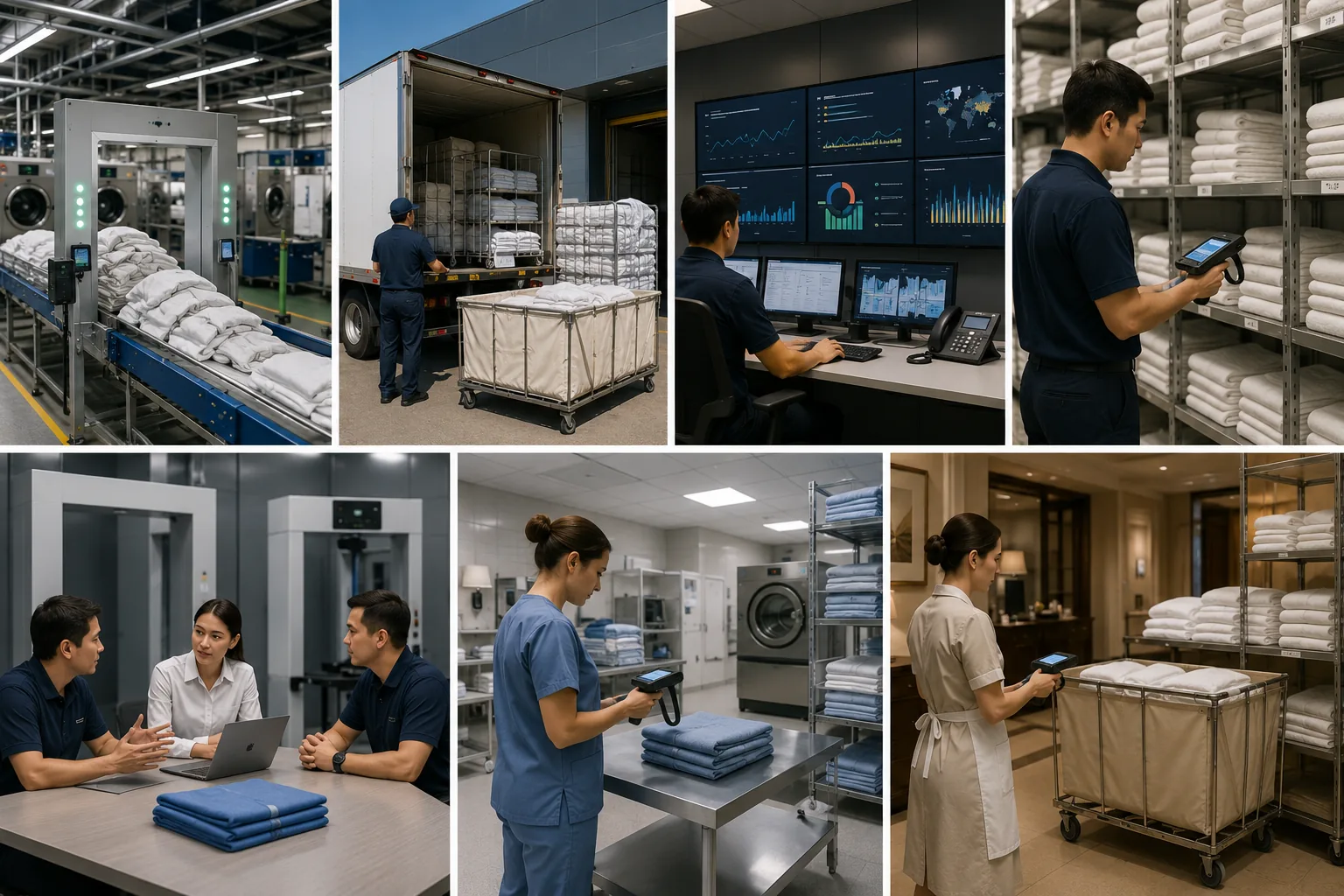
In practice, the answer is often a combination. Each step of the laundry cycle asks its own question, and each question has its own best tool.
| Process step | Question at this step | Option that often fits |
|---|---|---|
| Intake | How much has each customer sent back? | RFID portal or tunnel, reading whole carts |
| Sorting | Is each item in the right category and wash program? | RFID read station; camera for the item type |
| Quality check | Is the item clean and undamaged? | Camera and AI |
| Folding and packing | Is each item verified before it is packed? | RFID read station |
| Dispatch | What left for which customer? | RFID tunnel or portal |
| Repairs | What does this item need, and is anything else wrong with it? | Camera, barcode and RFID: the camera checks for stains or damage that may have been overlooked, RFID or barcode tracks the repair |
| Single lookups | Where is this item? | RFID and barcode: RFID shows which batch the item is in, the barcode identifies the piece within it |
| Handover between teams | Who is responsible for the load now? | A fixed handover routine |
You do not have to equip every step at once. Many laundries start with the three key stations, intake, drying and folding, and add others where the data shows a gap.
Questions to ask before you decide
- How many items do you process, and how often does each one circulate?
- Where do items go missing today, and at which step does nobody count?
- Are items handled one by one at that step anyway, or in carts and bags?
- Do you need a history per item and per customer, or only a count?
- Is the problem one of identity, which item it is, or of condition, what state it is in?
- What hardware and software do you already have, and does it work?
- What do your wash programs demand of an identifier: temperature, chemistry, pressure, sterilisation?
The answers usually point to one option per step. If they point to RFID, test the tags in your own process first: request samples of Saphire One through our enquiry form, and our page on Saphire One RFID laundry tags has the specification.
How we approach the choice
We start with your process, not with a technology. In a system check we look at your volumes, textile types, workflows and losses, and recommend for each step what fits: RFID, a barcode, a camera, a process change or a combination.
Where RFID fits, you can take the full system from us or only the part you are missing: our software for tags and hardware you already have, or three key stations instead of all six. Where it does not fit, we say so.
Our guide on how long RFID laundry tags last explains what decides how many cycles a tag reaches.
FAQ
 FAQ
Questions about
RFID, barcode and camera
Is RFID better than barcode for laundries?
Not in every case. RFID is better where volumes are high and whole carts have to be counted at intake and dispatch, because it reads many items at once without line of sight. A barcode can be enough where volumes are low and items are handled one by one anyway. The right choice depends on the process step.
What is the main difference between RFID and barcode?
A barcode needs line of sight and is read one item at a time, so each item has to be presented to a scanner. A passive UHF RFID tag is read by radio, without being visible and in bulk, so a full cart or bag is counted in one pass. Both identify an individual item and can build an item history.
Can barcodes survive industrial washing?
Codes made for laundries are designed for it, but a printed code has to stay readable through washing, drying and ironing for its whole life, and a faded or damaged code can no longer be scanned. An RFID laundry tag is read without being seen, so it does not depend on a readable surface. Saphire One is designed for 200 industrial wash cycles.
Can a camera system replace RFID in a laundry?
Not for identification. A camera with AI recognises the item type and visible condition, such as stains, holes or faded colour, but it does not identify one particular item across many cycles. It complements RFID well at the quality check: the tag says which item it is, the camera says what state it is in.
Can RFID and barcode be used together?
Yes. RFID can handle the bulk counts at intake and dispatch while barcode scanners stay in use for repairs and for identifying a piece within a batch. A laundry can also start with barcode and add RFID where counting becomes the bottleneck. In both cases the software has to link both identifiers to the same item record.
Is RFID worth it for a small laundry?
It can be, if the volume and the problem justify it. A smaller laundry can start with the three key stations, intake, drying and folding, instead of all six. If volumes are low and losses small, a barcode or a changed routine may pay off sooner, and we say so in the system check.
Does RFID need line of sight?
No. Passive UHF RFID tags are read by radio and do not have to be visible, so tags inside folded linen or a closed bag can be read. Read reliability still depends on the conditions: metal, water and very dense loads affect it, which is why read points are planned and tested on site. Saphire One reads at up to 12 m, based on EECC free-air testing under FCC conditions. Actual read range depends on reader setup, tag orientation, textile arrangement and operating environment.
Explore
More on RFID for laundries
Take the full system, or only the part you are missing. These pages go into each part and each industry.
- RFID laundry trackingHow tags, readers and software follow every textile through the laundry cycle, step by step.

- RFID laundry management systemDashboard, stock per customer, roles and integration: the software side of RFID in the laundry.
- RFID laundry tagsSaphire One: designed for 200 industrial wash cycles, sterilisation at 134 °C, sew-in or heat-seal.
- RFID linen trackingSheets, towels and table linen counted in bulk, with balances per customer for linen rental.
- Textile tracking softwareUse our software with tags and readers you already have, or as part of the full system.
- IndustriesWorkwear and uniform rental, healthcare, hospitality and linen rental: RFID by industry.
Blog
Related Blog
Technology
How long do RFID laundry tags last? Wash cycles, heat and pressure explained
Laundry tag life is counted in wash cycles, not years. What wears a tag out, from heat and chemistry to the extraction press, finishing and attachment, and how to test it in your own process.
Technology
UHF vs. HF RFID for laundry tags
How UHF and HF RFID differ in reading range, bulk identification and performance around water and metal, and why Leanwave recommends passive UHF RFID for tracking textiles throughout the laundry process, from intake to dispatch.