


Technology
What is an RFID tag? How it works, types and uses
The quick answer
An RFID tag is a small label or tag that stores an identification number and sends it by radio when a reader asks for it. RFID stands for radio frequency identification. Unlike a barcode, a tag does not have to be seen to be read, and a reader can identify many tags at once.
Most tags in use today are passive: they have no battery and draw their energy from the reader’s radio field. That is why they can be small, cheap to produce and last for years, even sewn into textiles that are washed, dried and ironed every week.
How does an RFID tag work?
Every RFID system has three parts: the tag, the reader with its antenna, and software that turns reads into information.
- The reader sends out a radio signal through its antenna.
- A passive tag in the field picks up part of that energy and wakes up.
- The tag answers with its identification number by reflecting the signal in a coded pattern.
- The reader passes the number to the software, which knows what the number stands for: an item, an owner, a place.
The tag itself usually stores only an ID. Everything else, such as the item type, the customer or the wash count, sits in the software and is looked up by that ID. Because the reader talks to tags by radio, it can read tags inside a closed bag or a full cart, as long as the radio signal gets through.
What an RFID tag is made of
A tag consists of a microchip that stores the ID and handles the radio protocol, and an antenna that receives and sends the signal. Both sit on or in a carrier: a paper or plastic label, a hard case, or a flexible textile tag. The carrier decides where a tag can be used. A paper label works on a box in a warehouse, but it would not survive a single industrial wash.
What is stored on an RFID tag?
Usually just a number. On passive UHF tags this is the EPC, the Electronic Product Code, a unique ID written to the tag. Some tags have room for more data, but in most applications, laundries included, the tag only identifies the item. What the item is, who owns it, how often it was washed and where it was last seen is kept in the software and looked up by that number. That keeps tags simple and the data in one place, where it can be corrected and shared.
How a reader reads many tags at once
When dozens or hundreds of tags are in the field at the same moment, they cannot all answer at once. The reader therefore runs a short protocol that lets the tags answer one after another in quick succession, so a full cart or a closed bag can be counted in one pass. This bulk reading is the main reason RFID is used where many items move together, and the main difference to a barcode, which has to be scanned item by item.
| RFID tag (passive UHF) | Barcode | |
|---|---|---|
| Line of sight | Not needed | Needed |
| Items per scan | Many at once | One |
| Read distance | Several metres, depending on setup | Close to the scanner |
| Inside bags or carts | Yes, if the signal gets through | No |
| Typical use | Counting many items at fixed points | Checking single items by hand |
Our guide RFID vs. barcode vs. camera compares the options for laundries in more detail.
Types of RFID tags
Passive tags
No battery. Powered by the reader’s field, small and long-lived. Read ranges from a few centimetres to several metres, depending on frequency, tag and setup. This is the type used in laundries, retail and logistics.
Active tags
With their own battery and transmitter. They can be read over longer distances and can send on their own, but they are larger, more expensive and stop working when the battery is empty. Used for vehicles, containers and large equipment.
Semi-passive tags
With a battery that powers the chip or a sensor, but answering like a passive tag. Used where a tag has to log data such as temperature between reads.
RFID frequencies: LF, HF and UHF
| Band | Frequency | Typical read range | Typical uses |
|---|---|---|---|
| LF (low frequency) | around 125 to 134 kHz | a few centimetres | Animal identification, access control |
| HF (high frequency) | 13.56 MHz | up to about a hand’s width | Payment and access cards, NFC, library books |
| UHF (ultra high frequency) | 860 to 960 MHz depending on region | several metres | Retail, logistics, textile and laundry tracking |
UHF is the band for reading many items quickly: a cart of linen at a gate, a closed bag at a portal. Most passive UHF tags follow the same standard, EPC Class 1 Gen 2 (ISO/IEC 18000-6C), so tags and readers from different makers work together. Our guide on UHF vs. HF RFID for laundry tags compares the two bands for textiles.
What limits the read range
A read range on a datasheet is measured under ideal conditions. In practice it depends on the reader, the antenna, the orientation of the tag and what is around it. Water and metal are the main obstacles: wet textiles absorb radio energy, and metal carts and machines reflect it. Tags lying very close together can also shield each other.
That is why read points are planned for the place they serve and tested with the real items. For our own tag, Saphire One, the read range is up to 12 m, based on EECC free-air testing under FCC conditions. Actual read range depends on reader setup, tag orientation, textile arrangement and operating environment.
What RFID tags are used for
- Retail: stock counts on the shop floor, goods receipt, theft protection.
- Logistics: pallets, containers and returnable packaging.
- Access and payment: cards and key fobs, usually HF or LF.
- Asset tracking: tools, equipment and IT in companies and hospitals.
- Textiles and laundries: workwear, flat linen and mats that are washed many times and have to come back.
RFID tags in textiles and laundries
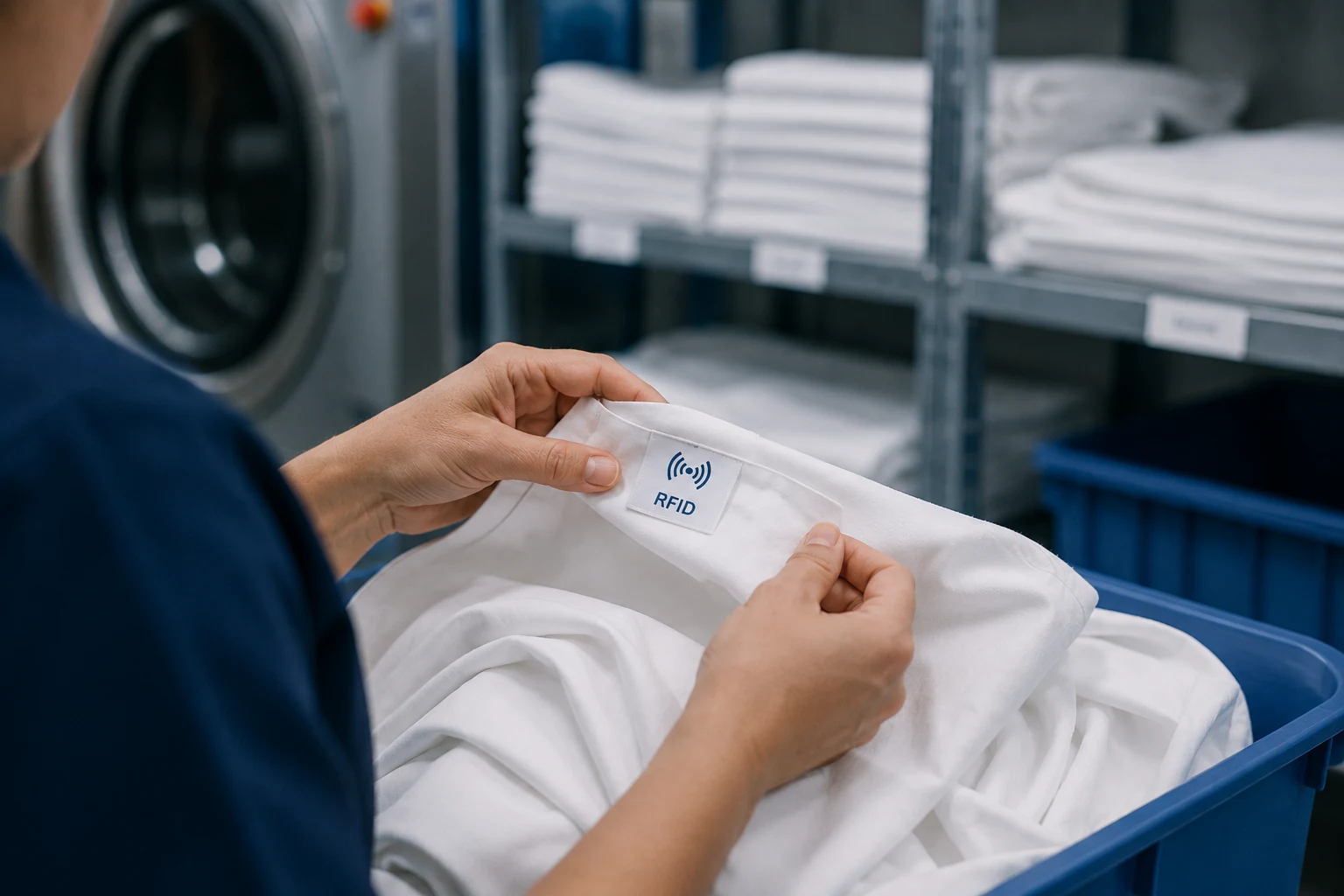
A laundry tag has a harder life than almost any other tag. It goes through hot wash programs and chemistry, the extraction press, dryers and ironers, often hundreds of times. It has to be flexible enough not to bother the wearer and robust enough to be read wet, in a dense load, in a metal cart.
Our own tag, Saphire One, is a passive UHF tag (860 to 928 MHz) designed for 200 industrial wash cycles, with 60 bar in the extraction press and sterilisation at 134 °C, certified to OEKO-TEX Standard 100. It comes as a sew-in and a heat-seal version. Tags are usually attached by the textile supplier, so new textiles arrive tagged. More on the tag: RFID laundry tags.
Which tag fits which textile is best decided with a test in your own wash programs, see our guide on how to choose an RFID laundry tag. Terms like EPC, gate or read point are explained in our RFID laundry glossary.
Limits of RFID tags
- A tag identifies an item, it does not locate it everywhere: an item is seen where a reader is.
- Water, metal and dense loads reduce the read range and need well planned read points.
- Tags can fail or be damaged, so processes need a way to find and replace them.
- For a single item at a single spot, a barcode can be enough. Our article When RFID Isn’t the Right Answer describes those cases.
FAQ
 FAQ
Questions about
RFID tags
What is an RFID tag in simple terms?
A small label or tag with a chip and an antenna that sends an identification number by radio when a reader asks for it. It does not have to be visible to be read, and many tags can be read at once.
Do RFID tags need a battery?
Passive tags, the most common kind, do not. They are powered by the reader’s radio field. Active tags have their own battery and are used where long ranges are needed.
Can you be tracked with an RFID tag?
A passive tag is only read when it is within range of a reader, so it shows where an item passed a read point, not where it is all the time. Laundry tags identify textiles, not people.
How much do RFID tags cost?
It depends on the type: simple paper labels for retail cost far less than tags built to survive industrial washing. For laundry tags, the cost per wash cycle matters more than the unit price. We give prices on request for your application.
How long do RFID tags last?
Passive tags have no battery to run out. In laundries their life is set by washing, pressing and drying. Saphire One is designed for 200 industrial wash cycles.
What is the difference between RFID and NFC?
NFC is a form of HF RFID for very short distances, used in phones and payment cards. UHF RFID reads over several metres and many items at once, which is why it is used for textiles and logistics.
Explore
More on RFID for laundries
Take the full system, or only the part you are missing. These pages go into each part and each industry.
- RFID laundry trackingHow tags, readers and software follow every textile through the laundry cycle, step by step.

- RFID laundry management systemDashboard, stock per customer, roles and integration: the software side of RFID in the laundry.
- RFID laundry tagsSaphire One: designed for 200 industrial wash cycles, sterilisation at 134 °C, sew-in or heat-seal.
- RFID linen trackingSheets, towels and table linen counted in bulk, with balances per customer for linen rental.
- Textile tracking softwareUse our software with tags and readers you already have, or as part of the full system.
- RFID for workwear and uniformsEvery garment linked to a wearer and a customer site, for uniform and workwear rental.
- RFID for healthcare laundriesHospital linen management with RFID: linen, scrubs and patient gowns per ward and hospital.
- Hotel linen trackingFor laundries serving hotels: see per property whether the planned stock of sheets and towels per room (the par level) is really there, with rental and hotel-owned linen kept apart.
- IndustriesWorkwear and uniform rental, healthcare, hospitality and linen rental: RFID by industry.
Blog
Related Blog
Technology
UHF vs. HF RFID for laundry tags
How UHF and HF RFID differ in reading range, bulk identification and performance around water and metal, and why Leanwave recommends passive UHF RFID for tracking textiles throughout the laundry process, from intake to dispatch.
Technology
How to choose an RFID laundry tag: heat, chemistry, pressure and wash cycles
The questions that decide which RFID laundry tag fits your textiles: your hardest wash program, the extraction press, sterilisation, the format and position on the item, and how to test before you order.
Technology
RFID laundry glossary: the terms explained
Short definitions of the RFID and laundry terms that come up when you plan tracking for textiles: tags, frequencies, read points, process steps and the figures laundries work with.