


Technology
RFID inventory management: how it works for textiles and laundries
The quick answer
RFID inventory management means keeping track of stock with RFID tags on the items and readers that record them. Instead of counting by hand or scanning barcodes one by one, readers identify many tagged items at once, without line of sight, and software turns those reads into stock figures per item, place and owner.
For goods that are counted once and sold, RFID mainly speeds up counting. For textiles that circulate between a laundry and its customers, it does more: every pass through a read point updates the stock, so the inventory follows from the process instead of from a stocktake.
How RFID inventory management works
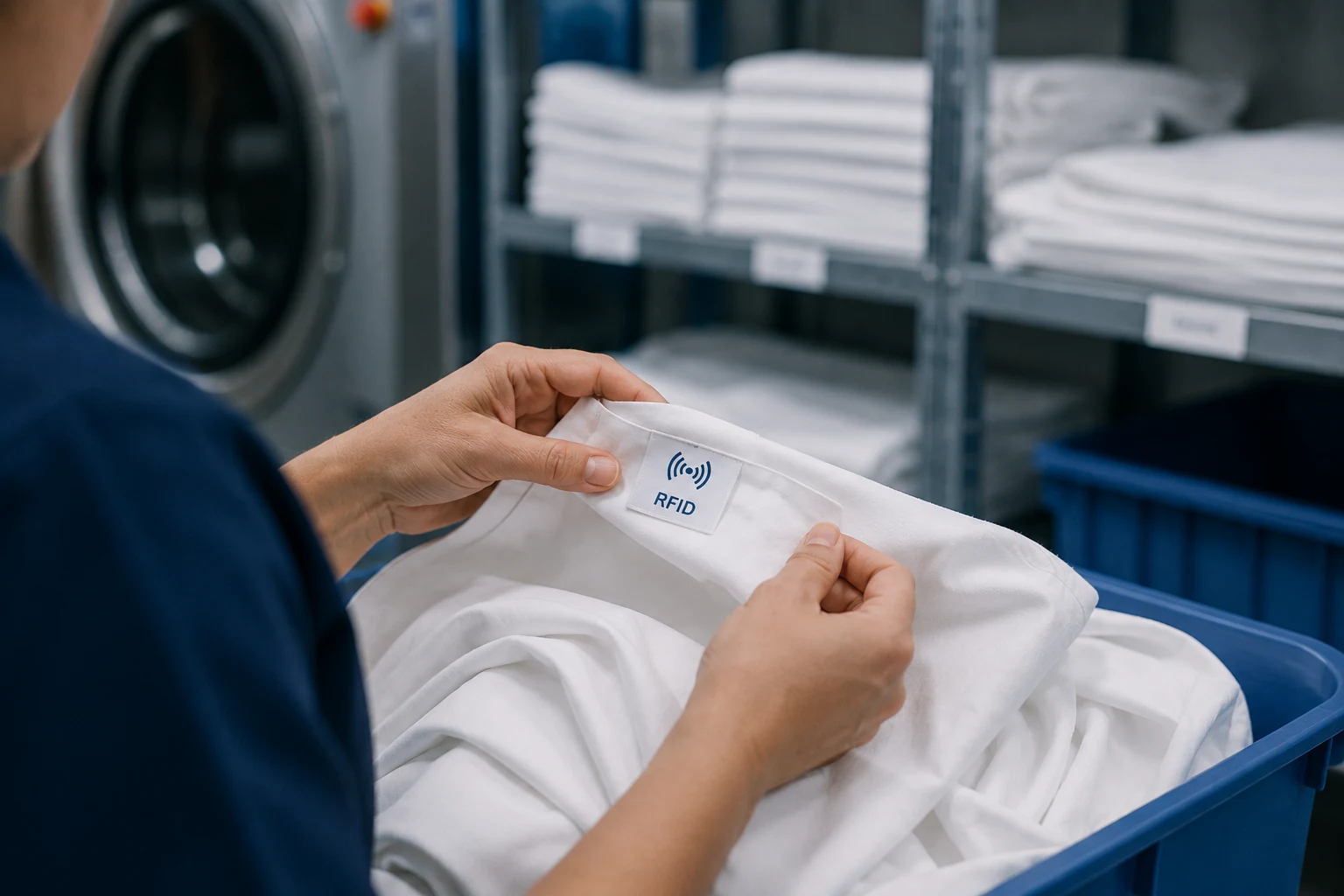
- Each item carries an RFID tag with a unique ID. In textiles this is a wash-resistant UHF tag, usually attached by the textile supplier.
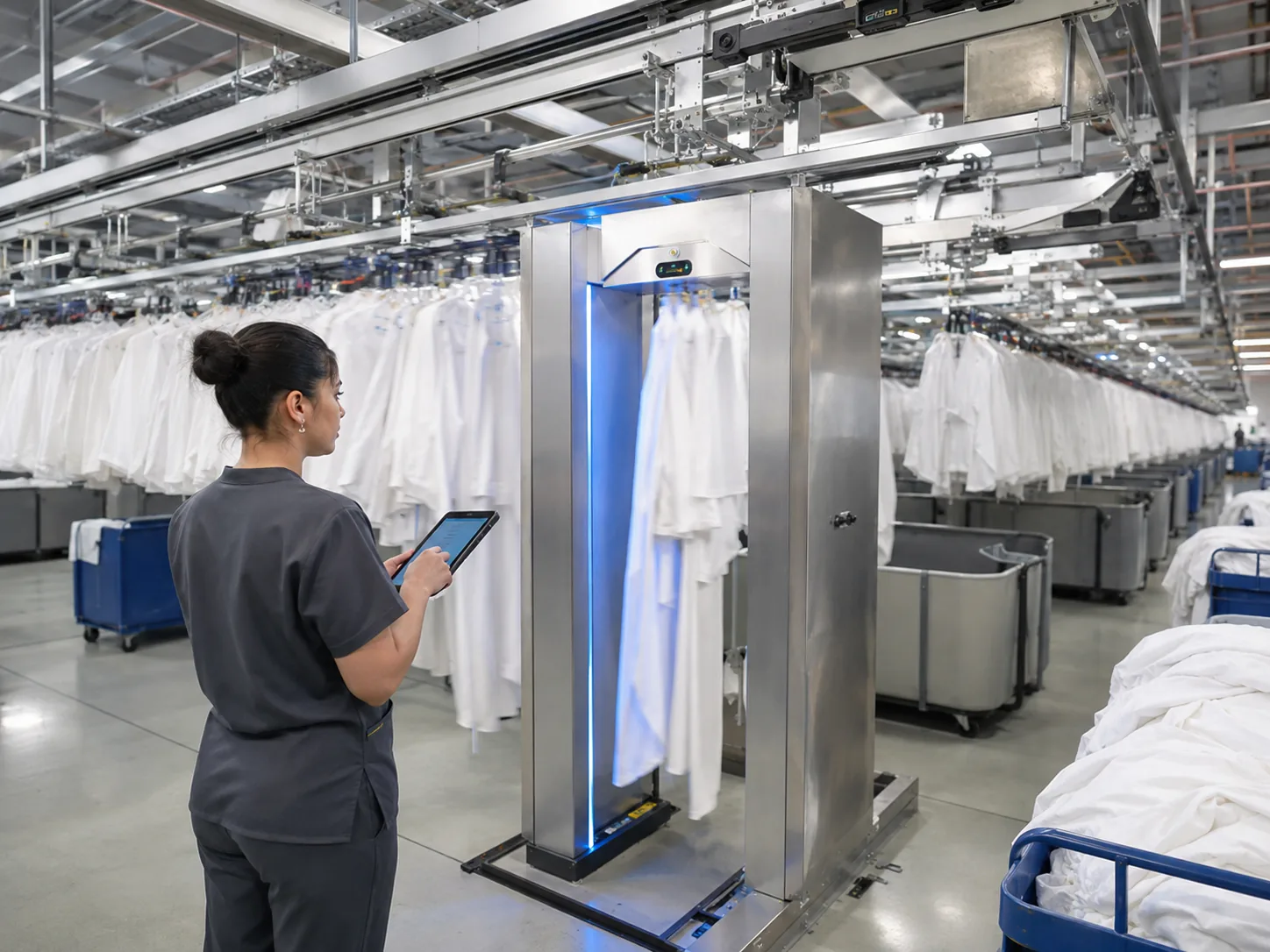
- Readers with antennas sit at fixed points where items pass, such as an intake, a dispatch dock or a cabinet. Handheld readers can be used for spot checks.
- Each read records the item, the place and the time.
- Software links the ID to what the item is and whom it belongs to, and keeps the count per place, customer and item type.
The tags themselves only carry an ID. Our guide What is an RFID tag? explains how tags and readers work together.
What an RFID inventory system consists of
An RFID inventory system consists of three main parts: tags, readers and software. Readers come in different types: fixed readers with antennas, gates and portals, and handheld readers.
| Part | Type | What it does | What to watch in a laundry |
|---|---|---|---|
| 1. Tags | Laundry tag | Carries a unique ID on each item | Must survive washing, drying, pressing and ironing |
| 2. Readers | Fixed readers and antennas | Read items as they pass a point | Placed where loads change hands; wet loads and metal carts need planning |
| 2. Readers | Gates and portals | Read a whole cart or bag in one pass | A gate is cheaper and faster, a portal costs more but encloses the load and reads more accurately |
| 2. Readers | Handheld readers | Spot checks and finding single items | Useful as an addition, not as the main count |
| 3. Software | Dashboard | Turns reads into stock per item, place and owner | Views per role: item history, stock per customer, delays, losses, lifetime |
The software is where inventory becomes useful. Our page on textile tracking software shows what the views look like for a laundry.
Stocktakes or read points
There are two ways to use RFID for inventory. In a stocktake, someone walks the shelves with a handheld reader and counts everything in one go, which is much faster than counting by hand. With fixed read points, the count happens continuously as items pass, and the stocktake becomes a check rather than a count from scratch.
Retail and warehouses often start with handheld stocktakes. For items that move in a loop, fixed read points at the handovers are the better fit, because the question is not only how many items there are, but where they are in the cycle and whether they came back.
Why textiles are different from warehouse stock
| Warehouse goods | Textiles in a laundry cycle | |
|---|---|---|
| Life of an item | Received, stored, shipped once | Delivered, used, collected and washed many times |
| Main question | How many are on the shelf? | Where is each piece, and did it come back? |
| Ownership | Usually one owner | Often per customer, sometimes rental and customer-owned side by side |
| Conditions | Dry, on shelves or pallets | Wet, hot, pressed, in dense loads and metal carts |
| Useful figures | Stock, turnover | Stock per customer, loss rate, wash cycles per piece |
This is why inventory management for textiles depends on read points where loads change hands, and on tags that survive industrial washing. Saphire One, our own tag, is designed for 200 industrial wash cycles and withstands 60 bar in the extraction press.
RFID compared with manual counts, spreadsheets and barcodes
| Method | How it works | Where it falls short |
|---|---|---|
| Counting by hand | Staff count shelves, carts and linen rooms | Slow, snapshots only, errors at high volumes |
| Spreadsheets | Counts and deliveries entered by hand | Only as good as the counts behind them |
| Barcodes | Each item scanned one by one | Needs line of sight, one item at a time |
| RFID with fixed read points | Items read in bulk where they pass | Needs tags on every item and planned read points |
For single items handled one by one, a barcode can be enough. Our comparison RFID vs. barcode vs. camera shows which fits where.
What RFID inventory management solves in a laundry
Stock per customer
Dispatch and return reads add up to a balance per customer and item type, so the agreed quantity can be checked at any time.
Losses
Items read at dispatch but never returned show where losses happen. With RFID, laundries can reach up to 70% less fabric loss, measured as the share of garments lost across the whole cycle. Our guide on linen loss explains how to measure it.
Wash cycles and lifetime
Every pass through the laundry is counted per piece, so replacement can be planned from real wash counts.
Proof of delivery and return
Reads per cart and per customer site document what was delivered and what came back, which settles disputes with facts.
Limits of RFID inventory management
- Every item needs a tag. New textiles usually arrive tagged, and existing textiles can be tagged as they circle back to the quality check station.
- Read points need planning: wet loads, metal carts and dense bags reduce the read range.
- A tag can fail, so the process needs a station where missing or defective tags are replaced, best at the quality check right after folding.
- Where the problem is a missing routine rather than missing data, a changed process may be the better fix. See When RFID Isn't the Right Answer.
How to get started
- Define what you want to know: stock per customer, losses, wash cycles, or proof of delivery.
- Measure today’s figures as a baseline.
- Plan read points for the whole laundry: in most laundries the key stations are intake, drying and folding, plus dispatch.
- Count returns where textiles are handed back: a fixed drop box at the customer or a movable cabinet on the delivery truck.
- Start the tags small, with one customer or one product line at one site.
Our guide on how to choose an RFID laundry system lists the questions to ask a provider. To look at your inventory with us, use our enquiry form.
FAQ
 FAQ
Questions about
RFID inventory management
What is RFID inventory management?
Keeping track of stock with RFID tags on the items and readers that record them. Readers identify many items at once without line of sight, and software turns the reads into stock figures per item, place and owner.
How does an RFID inventory system work?
Each item carries a tag with a unique ID. Readers at fixed points or handheld readers record the tags, and software links each ID to the item and keeps the count per place, customer and item type.
Is RFID better than barcodes for inventory?
For many items that move together: Yes, RFID reads in bulk and without line of sight. For single items handled one by one: A barcode can be enough.
Does RFID make inventory more accurate?
It removes most counting by hand, which is where many inventory errors come from. Accuracy still depends on well planned read points and a process for replacing defective tags. While RFID’s accuracy depends a lot on the installation, it is still by far more accurate than manual counting and barcodes.
Can RFID inventory management work for laundries?
Yes, with tags made for industrial washing and read points where loads change hands. The inventory then follows from intake, dispatch and return reads per customer.
Do we need handheld readers?
Not for the day-to-day count. Fixed read points do that as items pass. Handheld readers are useful for spot checks and for finding single items.
Can existing textiles be tagged?
Yes. Existing textiles can be tagged as they circle back to the quality check station. New textiles usually arrive tagged, attached by the textile supplier.
What does an RFID inventory system cost?
That depends on the number of items, the read points and the software you need. We cost it for your operation in a system check.
Explore
More on RFID for laundries
Take the full system, or only the part you are missing. These pages go into each part and each industry.
- RFID laundry trackingHow tags, readers and software follow every textile through the laundry cycle, step by step.

- RFID laundry management systemDashboard, stock per customer, roles and integration: the software side of RFID in the laundry.
- RFID laundry tagsSaphire One: designed for 200 industrial wash cycles, sterilisation at 134 °C, sew-in or heat-seal.
- RFID linen trackingSheets, towels and table linen counted in bulk, with balances per customer for linen rental.
- Textile tracking softwareUse our software with tags and readers you already have, or as part of the full system.
- RFID for workwear and uniformsEvery garment linked to a wearer and a customer site, for uniform and workwear rental.
- RFID for healthcare laundriesHospital linen management with RFID: linen, scrubs and patient gowns per ward and hospital.
- Hotel linen trackingFor laundries serving hotels: see per property whether the planned stock of sheets and towels per room (the par level) is really there, with rental and hotel-owned linen kept apart.
- IndustriesWorkwear and uniform rental, healthcare, hospitality and linen rental: RFID by industry.
Blog
Related Blog
Technology
What is an RFID tag? How it works, types and uses
What an RFID tag is, how a reader finds and reads it, the difference between passive and active tags and between LF, HF and UHF, what limits the read range, and what it takes for a tag to survive in textiles.

Insights
Linen loss and linen inventory: where textiles disappear and how to measure it
Where sheets, towels and garments leave the cycle, from the laundry floor to the customer site, how to measure linen loss without a full stocktake, and which measures actually reduce it.

Insights
How to choose an RFID laundry system: 12 questions to ask a provider
The questions that separate a working RFID laundry system from a box of hardware: process, tags, read points, software and the way a provider works with you, plus the answers that should make you think twice.