

RFID laundry
management system
One system from tag to invoice, planned around your process.
Request a system check
What an RFID laundry management system actually includes
What it covers
 What it covers
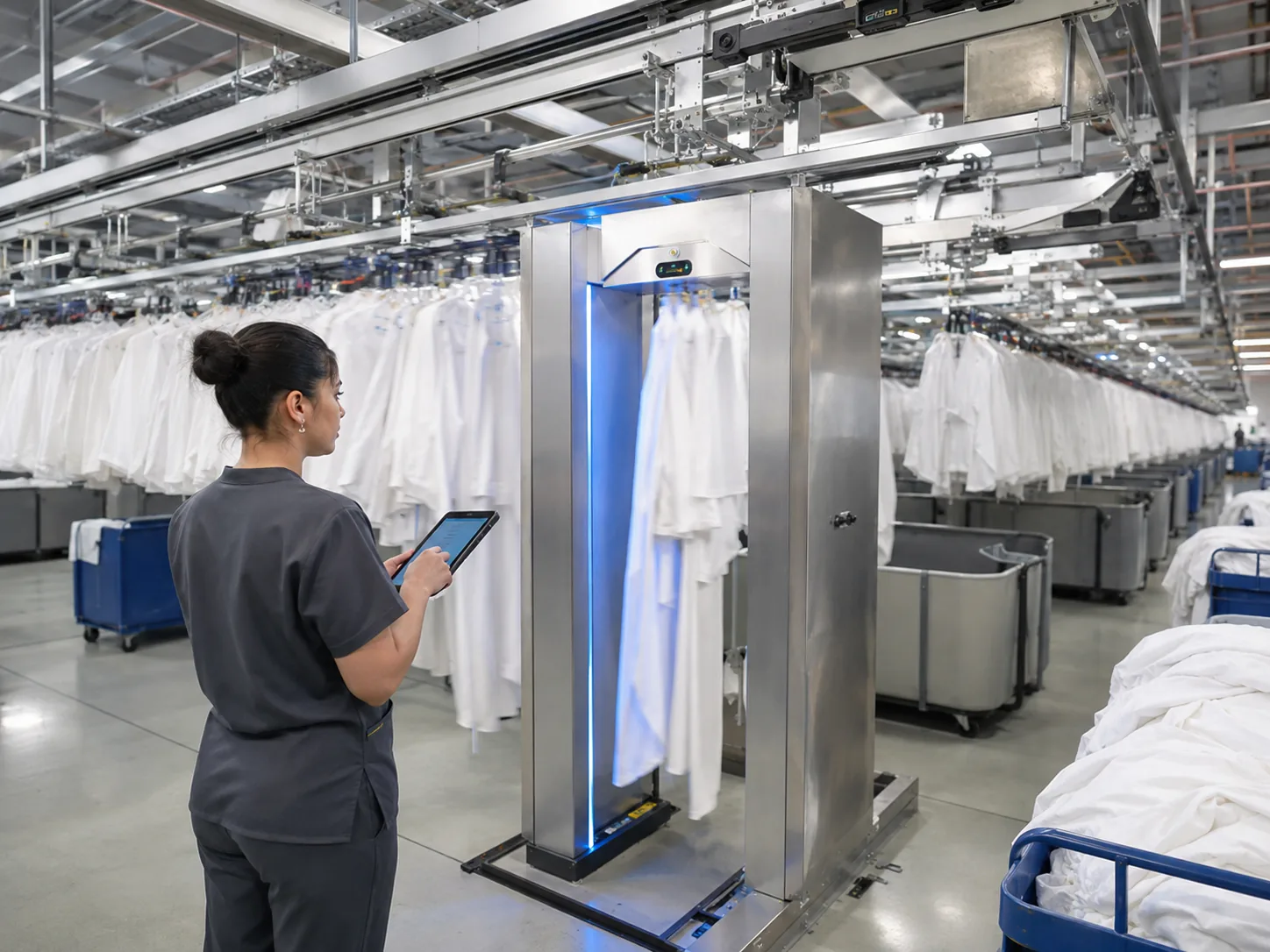
An RFID laundry management system is the complete set-up that lets a laundry identify every textile automatically and run its operation on that data. It has four parts: washable UHF tags in the textiles, reading points at the steps that matter, software that turns every read into data per item, customer and stock, and the process design that decides where all of this sits. Tracking is one function of the system. Management is what you do with the data: plan purchasing, settle losses with customers, compare sites and fix the steps where textiles stall. We plan, supply and support the system from one team, or only the part you are missing, and we start with your process, not with hardware.
System components
The building blocks of an RFID laundry system
Each part can be sized on its own. What matters is that they are planned together, because a tag, a reader and a software screen only create value as one chain.
Washable RFID tags
Every textile carries a passive UHF tag that is read without line of sight. Our main tag, Saphire One, is designed for 200 industrial wash cycles, sterilisation at 134 °C and 60 bar in the extraction press. For specialised applications we also offer the GENX2 Tag, Matt Tag, Gamma Tag and MRI Tag.
Reading infrastructure
Tunnels, portals and read stations capture tags where a count, an owner or a status changes. How many you need follows from your workflow, not from a standard package, and each station is configured for its place in the plant.
Software
The Leanwave dashboard turns every read into a record: which item, which customer, which step, which wash cycle. Each team sees the figures relevant to its role instead of raw scan lists.
Integration on request
If you want it, item, customer and delivery data can also be passed to the systems you use for planning and billing. It is an add-on, not part of a standard rollout.
Process consulting
Before anything is installed, we map how textiles move through your plant and where they get lost. If a step needs a different process rather than more technology, we say so.
Training and support
Training and support are agreed in your contract and match what you buy from us, from hardware only to a complete installation with training in your plant.



How the system works
How the layers
of the system
work together


1/3
Capture
A reading point registers every tag that passes, in bulk and without unpacking the cart. Each read carries three facts: which item, where and when. On its own, that is only a list of numbers.
Record
The software links each read to the item's master data: owner or customer, textile type, size, wash count, history and quality. A pass through the clean-side tunnel becomes a delivery for a named customer. A pass on the soiled side becomes a return.
Act
Records feed the dashboard. Purchasing sees which textiles are reaching the end of their life, controlling sees losses per customer, and production sees where work queues up.
Read-point strategy
Where the system reads,
and why
A system is only as good as its reading points. We place them where a count, an owner or a status changes, and choose the configuration for the conditions at that spot. Every station feeds the Leanwave dashboard, so each read becomes part of the item history, the stock per customer and the reports your teams use.
Intake dock
01Portal
Also possible: tunnel
Key station
You know what each customer has sent back before anything is unpacked. Differences against the delivery note surface at the dock, and counting by hand at intake falls away.
Sorting
02Read station
At the sorting table
Every piece lands in the right wash program. Wrong categories are caught before they cost a wash, and items due for repair or at the end of their planned cycles leave the flow.
Drying station
03Read station at the dryer
Automated, no extra handling
Key station
Drying gives far more time to read every tag than a quick pass through a portal, which makes it the most reliable read point in the plant and our redundancy point, without extra handling. Each completed cycle counts towards the item's history, so replacement rests on actual use.
Folding
04Tunnel
Also possible: read station
Key station
Clean, dry textiles read most reliably, so this is where each item is verified before it is packed. Shortages show up while there is still time to act, not at the loading dock.
Dispatch
05Tunnel
Also possible: shielded portal or in-cart reading
Your delivery record writes itself: which items went to which customer, in what quantity. Missing pieces are noticed while the cart is still on site.
Returns and customer site
06Portal
Also possible: tunnel, a read cabinet on the delivery truck or a drop box
Returns are counted the same way as at intake. At the customer, a small read station on the delivery truck or a drop box can record what goes back, so you see what has left dispatch and has not come back yet.
- You do not need all six. Start with the three key stations, intake, drying and folding, and add the others where the data shows a gap.
- More range is not always better: a dispatch tunnel shall not read the cart waiting behind it.
- Read rates depend on textile type, load density and surroundings. We measure them in the pilot, read point by read point, before anything is rolled out.


The software layer: the Leanwave dashboard
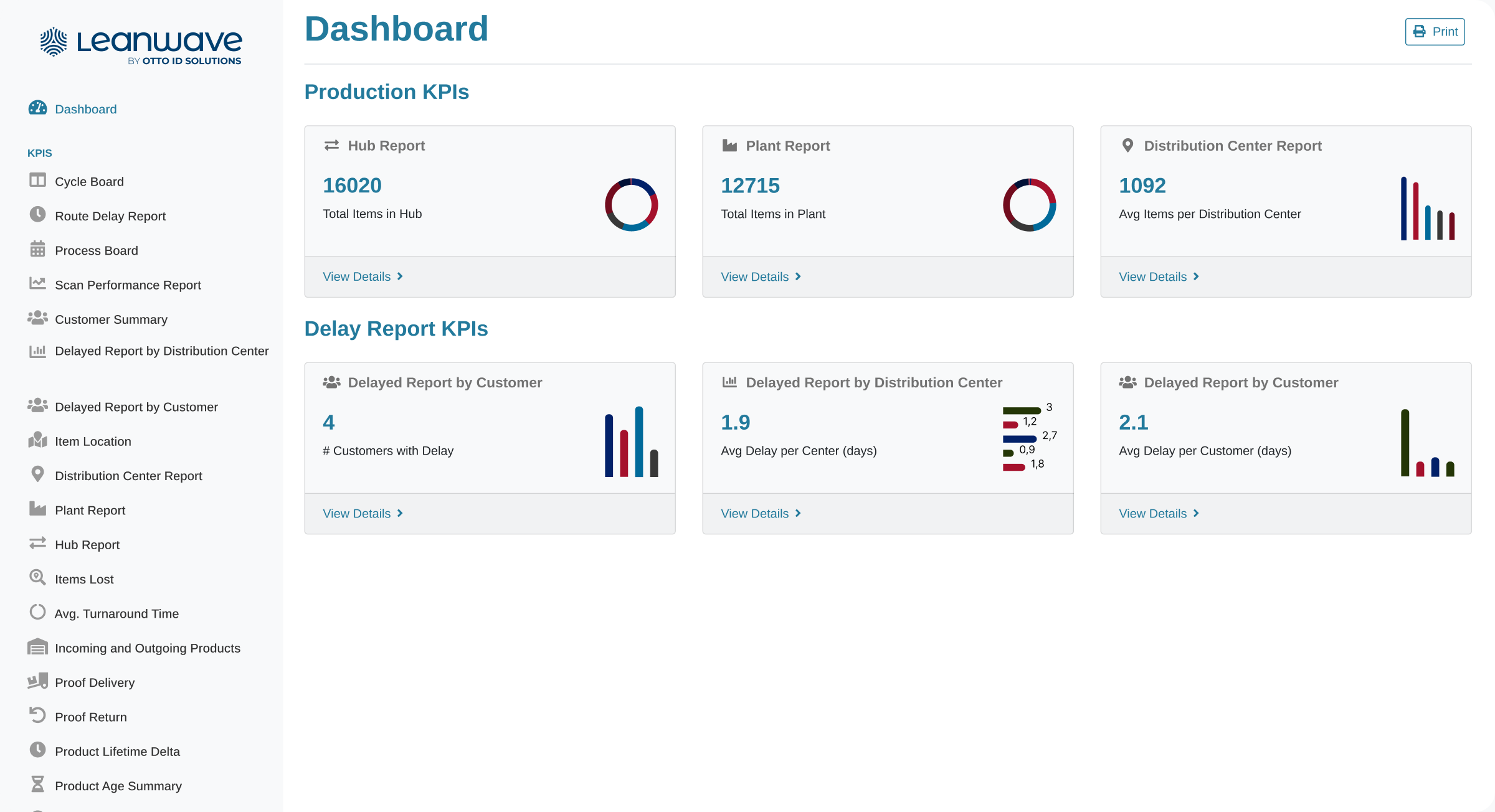

Every item, one history. Each textile has a record with its owner or customer, last recorded location, wash cycles and every movement, including quality notes from inspection.

Operations management. Stock by location and by customer, delays per distribution centre and per customer, and the steps where textiles stall.

Production. What is in the plant, what has come in and gone out, and which items were flagged at quality control, so the team plans its work on counts instead of estimates.

Purchasing. Wash cycles and age per item show which textiles are close to the end of their life, so replacements are ordered on evidence.

Controlling. Losses and circulation per customer and per site, as a dependable basis for billing and for discussing loss charges with customers.

Management across sites. One view over all locations with the same definitions everywhere, so sites can be compared fairly.
Integration
Connected to the systems you already run
A standard rollout runs on the Leanwave dashboard alone. Where a laundry asks for it, we connect the system to software and hardware it already uses instead of replacing what works.
ERP and production software
On request, item and customer data can be exchanged with your ERP, so nobody keeps two lists. We support this as an add-on.
Billing
Delivered and returned quantities per customer are on record in the dashboard, and missing items are documented per customer for loss charges. A link to invoicing is available on request.
Existing hardware
Readers, cabinets and tags you already use are assessed first. Replacing them is an option, not a precondition.

Implementation
Implementing the system, step by step
We roll out in stages, so the system proves itself on one line or one customer before it reaches the whole plant. Each step ends with a decision: you can stop after the analysis if RFID turns out not to be the right answer.
1/6
01 Process analysis. We walk your plant, follow the textile flow and record today's counts, losses and manual effort. This baseline is what every later result is measured against.
02 System design. Reading points, tag type and attachment, dashboard scope and interfaces are defined in one plan. Steps that need a process change rather than RFID are marked as such.
03 Tag test. Sample tags go through your own wash programs and reading points. You decide on the tag after seeing how it performs in your conditions. Samples can be requested through our enquiry form.
04 Pilot. The reading hardware is planned for the whole laundry and the dashboard for the whole RFID set-up. What starts small are the tags: the textiles of one customer or one product line at one site. We check read reliability, data quality and whether the figures help the people who use them.
05 Rollout. Reading points are installed across the plant, and tags go into new textiles before they enter circulation, so the tagged pool grows with your normal replacement.
06 Operation and improvement. Teams are trained in their own plant. After go-live we review the figures with you and adjust reading points or reports where the data shows a gap.
Multi-site
One system across several sites
Each laundry runs differently, so the hardware configuration and the processes are planned for every plant on its own. What carries over from site to site are the read points, the tags and the dashboards.
One data model
Item, customer and status definitions are the same at every stage and every site, so a loss at one plant means the same as a loss at another.
Transfers between sites
Textiles that move between plants or distribution centres stay on record, with the sending and the receiving site in their history.
Site by site
The rollout follows the pilot logic: one site first, then the next, with the RFID set-up adapted to each building.

Honest assessment
When RFID is
not the answer
If RFID is the answer, we build with RFID. If it isn't, we find what is. RFID is our core expertise, but it is one tool among several, and the right one depends on the step in your process.
RFID
| Fits when | Volumes are high, items circulate many times and you need counts and histories per item and per customer. |
|---|---|
| Limits | Every item needs a tag and every read point needs hardware, so volume and losses have to justify the investment. Metal-heavy areas need a carefully planned reading zone. |
| Typical use | Intake and dispatch counts, rental balances, wash counts. |
Barcode
| Fits when | Volumes are lower, items are handled one by one anyway and the budget per item is tight. |
|---|---|
| Limits | Needs line of sight and reads one item at a time. Printed codes have to stay readable through industrial washing. |
| Typical use | Manual check stations, small textile pools, looking up a single item. |
Camera and AI
| Fits when | What matters is visible, such as whether an item is clean, stained or damaged, or what type it is. |
|---|---|
| Limits | Recognises a type or a condition, not the identity of one particular item across many cycles. Needs fixed positions and controlled lighting. |
| Typical use | Telling you whether a garment is broken, stained or has lost colour, which also helps with sorting. |
Process change
| Fits when | Losses or delays come from the workflow itself, such as unclear handovers, a step where nobody counts, or a bottleneck. |
|---|---|
| Limits | Depends on routines being followed and produces no item history. |
| Typical use | A fixed handover routine, a reorganised dispatch area, a counting step where none exists. |
Often the answer is a combination: RFID at intake and dispatch, a camera at the quality check, a changed routine at the handover.
Request a system checkFAQ
Questions about RFID laundry
management systems
What is the difference between an RFID laundry management system and RFID laundry tracking?
RFID laundry tracking is one function; an RFID laundry management system is the whole set-up around it. Tracking records where each textile was read along the laundry cycle. The management system adds the software, the multi-site structure and the process design that turn those reads into purchasing, billing and planning decisions. For the step-by-step view of reads along the cycle, see our page on RFID laundry tracking.
How much does an RFID laundry management system cost?
There is no fixed price, because the cost depends on your operation. A useful estimate separates one-off costs, such as reading infrastructure and software set-up, from running costs, such as tags for new textiles, software and support. The two variables that move the budget most are the number of textiles you tag and the number of reading points. We do not publish prices, because every system is sized to the operation; a system check gives you a costed plan.
Can an RFID laundry management system integrate with our ERP and billing software?
Yes, as an add-on on request. A standard rollout runs on the Leanwave dashboard alone. If you want data to reach your ERP or billing software, we define which data flows in which direction during system design, before anything is installed.
Can one system run across several laundry sites?
Yes. The Leanwave dashboard can show figures across several plants and distribution centres with shared item and customer definitions, so sites are comparable. Each laundry still gets its own hardware configuration, because every plant runs differently. Textiles that move between sites keep their full history, including the sending and the receiving location.
How long does it take to implement an RFID laundry management system?
It depends on the size of the project and the environment of the set-up, so we do not quote a general duration. Every project runs through the same six stages: process analysis, system design, tag test, pilot, rollout and ongoing improvement, and the pilot sets the pace.
Does RFID technology work in an industrial laundry?
Yes, UHF RFID works in industrial laundries when tags, readers and reading points are matched to the conditions. The tag has to survive the wash: Saphire One is designed for 200 industrial wash cycles. The readers have to be placed with metal, water and dense loads in mind. That is why we test sample tags and reading points in your own plant before any rollout.
What can destroy an RFID laundry tag?
A laundry tag fails when it is exposed to conditions beyond its specification or when it is attached badly. Saphire One is specified for sterilisation at 134 °C and 60 bar in the extraction press, and requirements above 134 °C can be met on request. A heat seal that was not pressed correctly can fail over time, which is why tag attachment is part of the system design, not an afterthought.
Can RFID tags survive industrial washing?
Yes, tags made for laundries go through the full industrial cycle with the textile. Saphire One is designed for 200 industrial wash cycles, sterilisation at 134 °C and 60 bar in the extraction press, and it is certified to OEKO-TEX Standard 100 (product class I). It comes as a sew-in tag (70 × 10 mm) or a heat-seal tag (72 × 12 mm). Details are on our RFID laundry tags page.
Can RFID follow textiles through the entire laundry cycle?
Yes, as long as there is a reading point at each step you want to see. The system records an item every time it passes a reader, from soiled intake to clean dispatch and back from the customer. Between reading points the record shows the last known location, which is why the read-point design matters as much as the tag. The step-by-step view is on our RFID laundry tracking page.
Is an RFID laundry management system suitable for smaller laundries?
It can be, but it should be sized to the problem. A smaller laundry can start with three key stations, intake, drying and folding, instead of all six, or use only our software with tags and readers it already has. If volumes are low or losses small, a barcode system or a changed routine may pay off sooner. We tell you that in the system check rather than selling more hardware than you need.
Which industries benefit most from an RFID laundry management system?
Operations with large textile pools that circulate between laundry and customer benefit most: workwear and uniform rental, healthcare linen and garments, and hotel linen. What they share is the need for accountability per item across many wash cycles. Healthcare adds sterilisation requirements, and Saphire One is specified for 134 °C.
Can RFID tags on textiles be tracked anywhere?
Only within range of a reader. A passive UHF tag has no battery and no GPS; it answers when a reader energises it, at up to 12 m with Saphire One, based on EECC free-air testing under FCC conditions; actual read range depends on reader setup, tag orientation, textile arrangement and operating environment. Outside the reading points in the laundry and at the customer, the system knows where an item was last read, not its position at any other moment.
Explore
More on RFID for laundries
Take the full system, or only the part you are missing. These pages go into each part and each industry.
- RFID laundry trackingHow tags, readers and software follow every textile through the laundry cycle, step by step.

- RFID laundry tagsSaphire One: designed for 200 industrial wash cycles, sterilisation at 134 °C, sew-in or heat-seal.
- RFID linen trackingSheets, towels and table linen counted in bulk, with balances per customer for linen rental.
- Textile tracking softwareUse our software with tags and readers you already have, or as part of the full system.
Find out what your laundry actually needs
In a system check we look at your textile flow, your current counts and your existing hardware. Then we tell you whether an RFID laundry management system pays off for you, which parts you need, and where a simpler fix will do. Need tags first? Request samples through our enquiry form.