


Technology
How to choose an RFID laundry tag: heat, chemistry, pressure and wash cycles
The quick answer
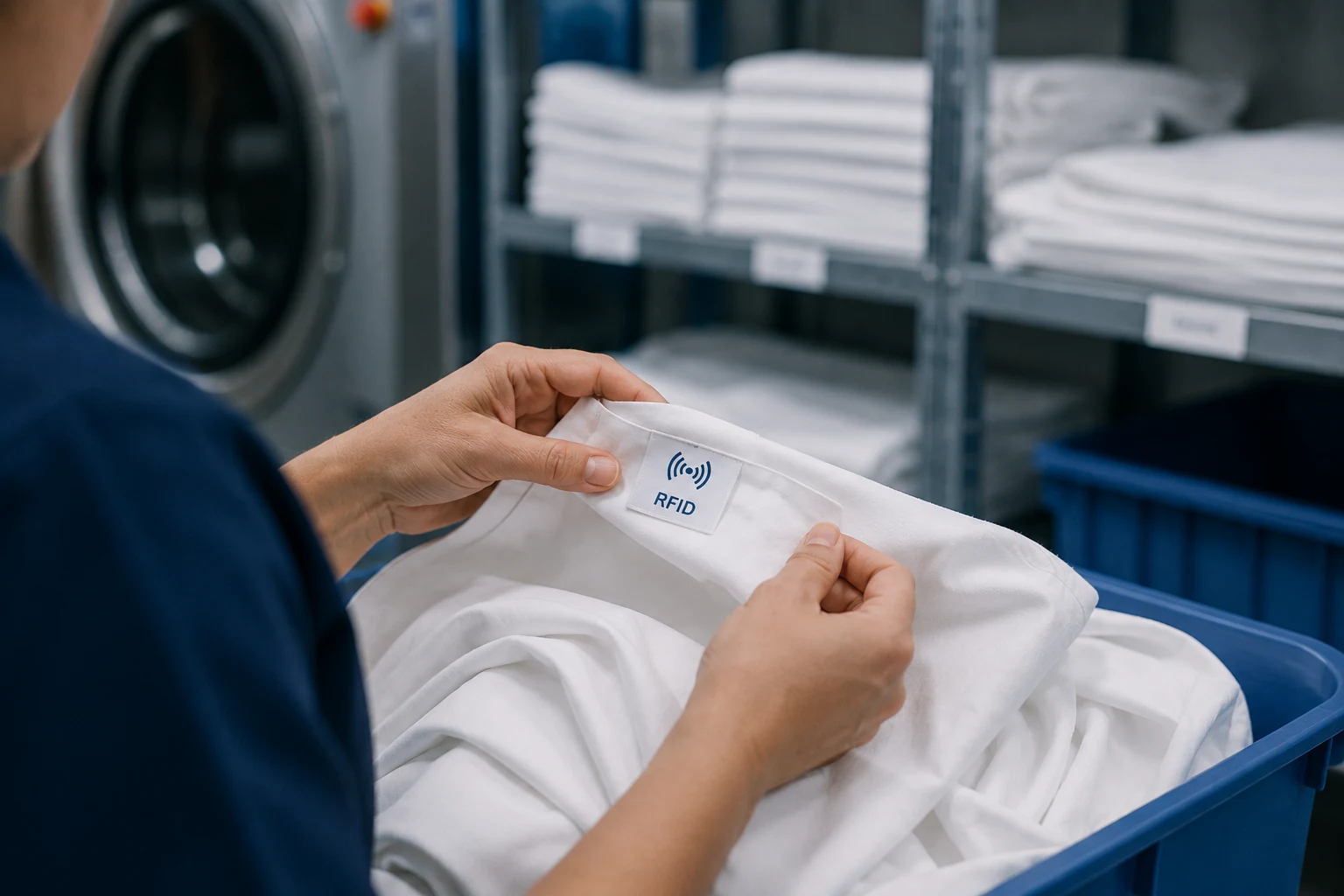
Choose an RFID laundry tag by your hardest process, not by your average one. The tag has to survive your hottest wash program, your most aggressive chemistry, the pressure in your extraction press and, in healthcare, sterilisation, for as many cycles as the textile lasts. It has to be read reliably in full carts and closed bags, which in practice means a passive UHF tag. And it has to sit in the right place on the item, attached the right way.
Our standard tag, Saphire One, is designed for 200 industrial wash cycles, 60 bar in the extraction press and sterilisation at 134 °C, is certified to OEKO-TEX Standard 100, product class I, and comes as a 70 × 10 mm sew-in or a 72 × 12 mm heat-seal tag. Whether it fits your process is decided the same way as for any tag: in a test on your own textiles.
Start with your hardest wash program
Every laundry has one program that is harder on tags than the rest: the hottest disinfection wash, the most aggressive chemistry for heavily soiled workwear, or the longest drying cycle. A tag that is specified for that program will last in all the others. A tag chosen for the average program will fail first in exactly the textile groups where losses hurt most.
Write down, per textile group, the highest temperature, the chemistry, the drying and finishing steps and how often the item is washed. That list is the brief for the tag choice, and it is the first thing we ask for in a system check.
| Question | Why it matters |
|---|---|
| Hottest wash and disinfection program | Heat over many cycles is the main load on a tag |
| Chemistry in that program | High temperature and aggressive chemistry together are harder than either alone |
| Extraction press or spinning | Pressure and mechanical load per cycle |
| Sterilisation, if any | Healthcare textiles need a tag specified for it |
| Ironer, tunnel finisher or press | Heat and contact pressure at finishing |
| Washes per item per month | How fast the tag uses up its cycles |
Heat, chemistry and sterilisation
Wash temperatures, thermal disinfection and the heat of dryers and finishers all load the tag, and the load adds up over many cycles. Chemistry matters as much: alkaline main washes, bleaching and oxidising agents and neutralisers act on the tag and on the way it is fixed to the fabric.
Healthcare adds sterilisation. Saphire One is specified for sterilisation at 134 °C. For other requirements we offer specialised tags, including the Gamma Tag and the MRI Tag; tell us about your process and ask us which one fits.
OEKO-TEX Standard 100 is a separate question. It concerns harmful substances in textiles worn next to the skin, not how long a tag lasts, and both should be checked.
The extraction press
In a tunnel washer line, the load goes from the wash into an extraction press that squeezes the water out under high pressure. For a tag this is one of the hardest moments in the cycle, especially if a hard object such as a button, zip or buckle sits on top of it.
Saphire One is specified for 60 bar in the extraction press. Find out what pressure your press runs at before the tag test; it is one of the settings that most clearly separates a tag that lasts from one that does not. Laundries that spin rather than press load the tag through centrifugal force and tumbling instead, and here too a test in your own machines gives the answer.
UHF, because the tag has to be read in bulk
A laundry tag has to be read where textiles change hands: in full carts at intake and dispatch, in closed bags, at drying and folding. That calls for passive UHF RFID, which reads many tags at once over several metres and without line of sight. Saphire One works from 860 to 928 MHz and reaches up to 12 m, based on EECC free-air testing under FCC conditions; actual read range depends on reader setup, tag orientation, textile arrangement and operating environment.
Read performance matters as much as durability. Cheaper tags often need much more reader power, and when many of them lie close together, as in a full cart, the proximity effect means some are not read at all. Our guide on UHF vs. HF RFID for laundry tags explains the difference between the two frequency bands.
Format, position and attachment
Saphire One comes in two formats, both 1.6 mm thick: a sew-in tag of 70 × 10 mm and a heat-seal tag of 72 × 12 mm. Sew-in suits garments and items that are sewn or repaired anyway; heat-seal suits tagging in volume where a heat press is available.
Position follows the item. On linen and towels the tag sits at the side or in a corner, never in the middle. On garments it can sit in a seam, but usually it goes on the back label. The tag withstands the heat of the ironer, so a tag inside the textile can go through the ironer as it is.
Attachment is usually done by the textile supplier before the textiles are delivered. The main risks are a seam sewn over the antenna, which breaks the connection and makes the tag unreadable, and a tag that is folded or fitted the wrong way. Agree the attachment process with your supplier, and keep a heat press or sewing machine at the quality check station for pieces with a defective or missing tag.
Test before you order
Specifications describe tested conditions. Your laundry has its own. The reliable way to choose is to run sample tags through your process.
- Pick the textile groups with the hardest treatment.
- Have samples attached the way your supplier will attach them in production.
- Run them through your normal process and read them at fixed points, so every cycle is counted.
- Check read results, attachment and visible damage at regular intervals.
- Compare the results with your planned textile life before you decide.
Request samples of Saphire One through our enquiry form. Our page on Saphire One RFID laundry tags has the full specification, and our guide on how long RFID laundry tags last explains what decides tag life.
FAQ
 FAQ
Questions about
choosing a laundry tag
What should I look for in an RFID laundry tag?
Durability in your hardest wash program, the extraction press and, where it applies, sterilisation; reliable bulk reading in full carts and bags, which means passive UHF; a format that fits your items; and an attachment your supplier can apply correctly. Test samples on your own textiles before deciding.
Are retail RFID labels suitable for laundries?
No. Retail labels are made for one trip through a shop, not for industrial washing, drying, pressing and finishing. A laundry needs a tag made for industrial processing, such as Saphire One, which is designed for 200 industrial wash cycles.
Sew-in or heat-seal?
Both work. Sew-in suits garments and items that are sewn or repaired anyway. Heat-seal suits tagging in volume where a heat press is available. Saphire One comes as a 70 × 10 mm sew-in and a 72 × 12 mm heat-seal tag, both 1.6 mm thick.
Where should the tag sit on the textile?
On linen and towels at the side or in a corner, never in the middle. On garments it can sit in a seam, but usually it goes on the back label. The tag withstands the heat of the ironer.
Can one tag type cover healthcare textiles?
Saphire One is specified for sterilisation at 134 °C and is used for scrubs, linen and garments. For specialised requirements we also offer the Gamma Tag and the MRI Tag. Ask us which one fits your process.
Why do cheap tags cost more in the end?
Because they often need much more reader power and are missed when many lie close together, the proximity effect. Missed reads, early failures and re-tagging cost more than the difference in tag price.
How do we get samples?
Request samples of Saphire One through our enquiry form. We help you set up the test in your own process.
Explore
More on RFID for laundries
Take the full system, or only the part you are missing. These pages go into each part and each industry.
- RFID laundry trackingHow tags, readers and software follow every textile through the laundry cycle, step by step.

- RFID laundry management systemDashboard, stock per customer, roles and integration: the software side of RFID in the laundry.
- RFID laundry tagsSaphire One: designed for 200 industrial wash cycles, sterilisation at 134 °C, sew-in or heat-seal.
- RFID linen trackingSheets, towels and table linen counted in bulk, with balances per customer for linen rental.
- Textile tracking softwareUse our software with tags and readers you already have, or as part of the full system.
- IndustriesWorkwear and uniform rental, healthcare, hospitality and linen rental: RFID by industry.
Blog
Related Blog
Technology
How long do RFID laundry tags last? Wash cycles, heat and pressure explained
Laundry tag life is counted in wash cycles, not years. What wears a tag out, from heat and chemistry to the extraction press, finishing and attachment, and how to test it in your own process.
Technology
UHF vs. HF RFID for laundry tags
How UHF and HF RFID differ in reading range, bulk identification and performance around water and metal, and why Leanwave recommends passive UHF RFID for tracking textiles throughout the laundry process, from intake to dispatch.
Technology
RFID laundry glossary: the terms explained
Short definitions of the RFID and laundry terms that come up when you plan tracking for textiles: tags, frequencies, read points, process steps and the figures laundries work with.