



Insights
How to choose an RFID laundry system: 12 questions to ask a provider
The quick answer
Choose an RFID laundry system by your process, not by a catalogue. A good provider starts with how textiles move through your laundry and to your customers, tests tags in your own wash programs, places read points where the data is worth having, and is open about where RFID does not help. The twelve questions below show quickly whether a provider works that way.
Before you talk to providers
The better you know your own starting point, the easier it is to compare answers. Four things are worth preparing.
- Your flows: where textiles come in, which stations they pass, where they leave and where they are handed back.
- Your item types and customers: which textiles you handle, for whom, and which of them cause the most trouble today.
- Your problem in one sentence: losses per customer, missing wash counts, disputes about deliveries, or something else.
- A baseline: today’s figures for the problem you want to solve, measured over a fixed period, so a pilot can be judged against them.
With this on the table, every provider answers the same questions about the same laundry, and the differences show quickly. Our overview of laundry KPIs helps to define the baseline.
Questions about your process
1. How will you learn how our laundry works?
Expect a look at your flows, customers, item types and handovers before any proposal. A quote without that step is a quote for hardware, not for a system.
2. Which problems should RFID solve for us, and which not?
A provider should name the problems RFID solves in your case, such as losses per customer or missing wash counts, and the ones it does not. Sometimes a changed routine or a barcode is the better answer. Our article When RFID Isn't the Right Answer describes those cases.
3. Can we start with part of the system?
Not every laundry needs everything at once. Some start with software for the data they already have, some with three read points instead of six. Ask what a partial solution looks like and how it grows.
Questions about tags
4. How will you test tags in our textiles and wash programs?
Tags should be tested in your hardest wash program, through your extraction press, dryers and ironers, on your textiles, before you order. Our guide on how to choose an RFID laundry tag lists what to test.
5. Where should the tags be attached?
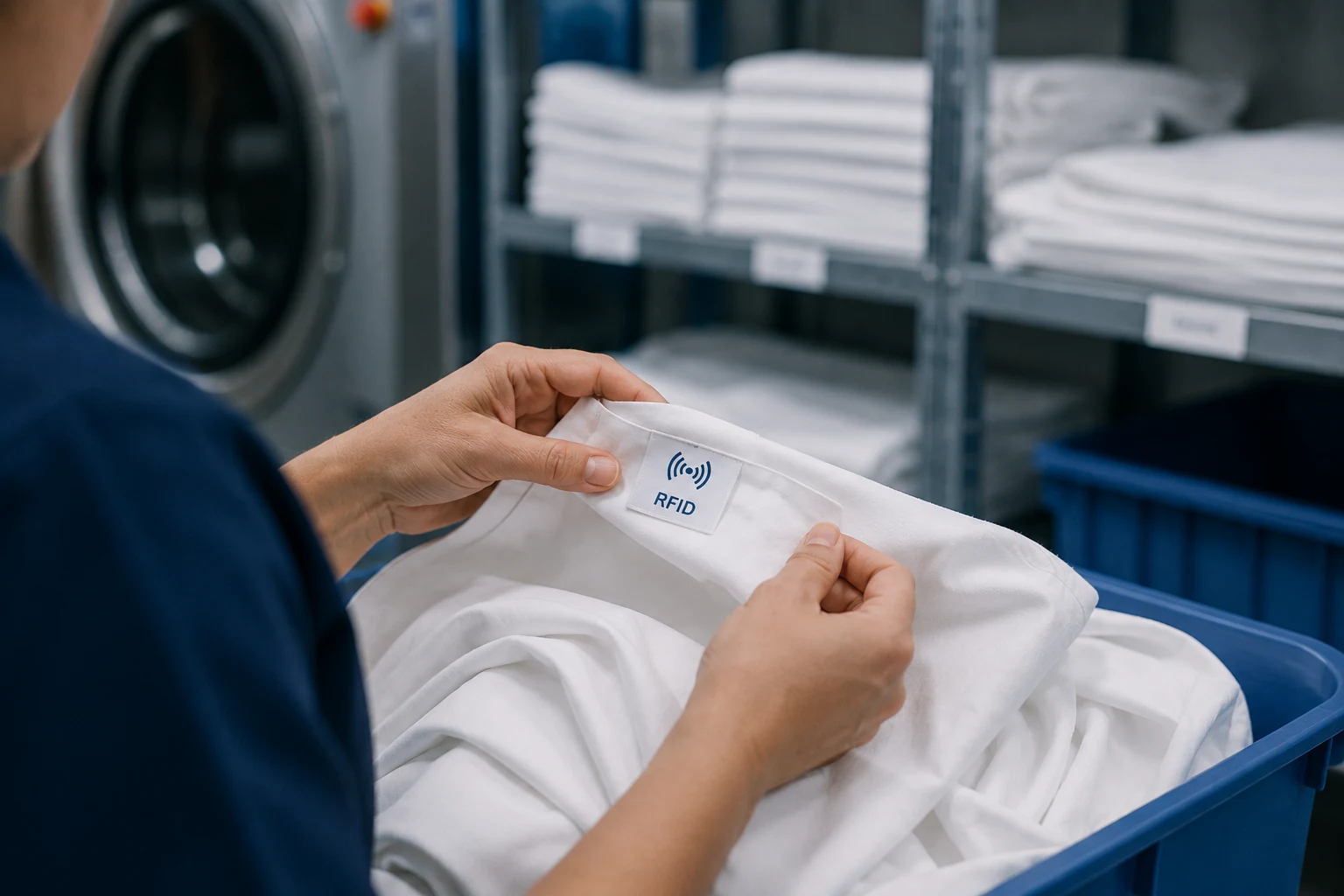
Ask about tag position (on flat linen at the side or in a corner, on garments usually at the back label) and how defective tags are replaced. Re-tagging belongs at the quality check station right after folding.
6. What do the tag specifications mean in our conditions?
Ask how wash cycles, temperature, pressure and read range were measured and what they mean in your plant. A read range from a datasheet is a test value; in a wet, dense load the result depends on the setup. Our guide on how long RFID laundry tags last explains the factors.
Questions about read points and hardware
7. Where will you read, and why there?
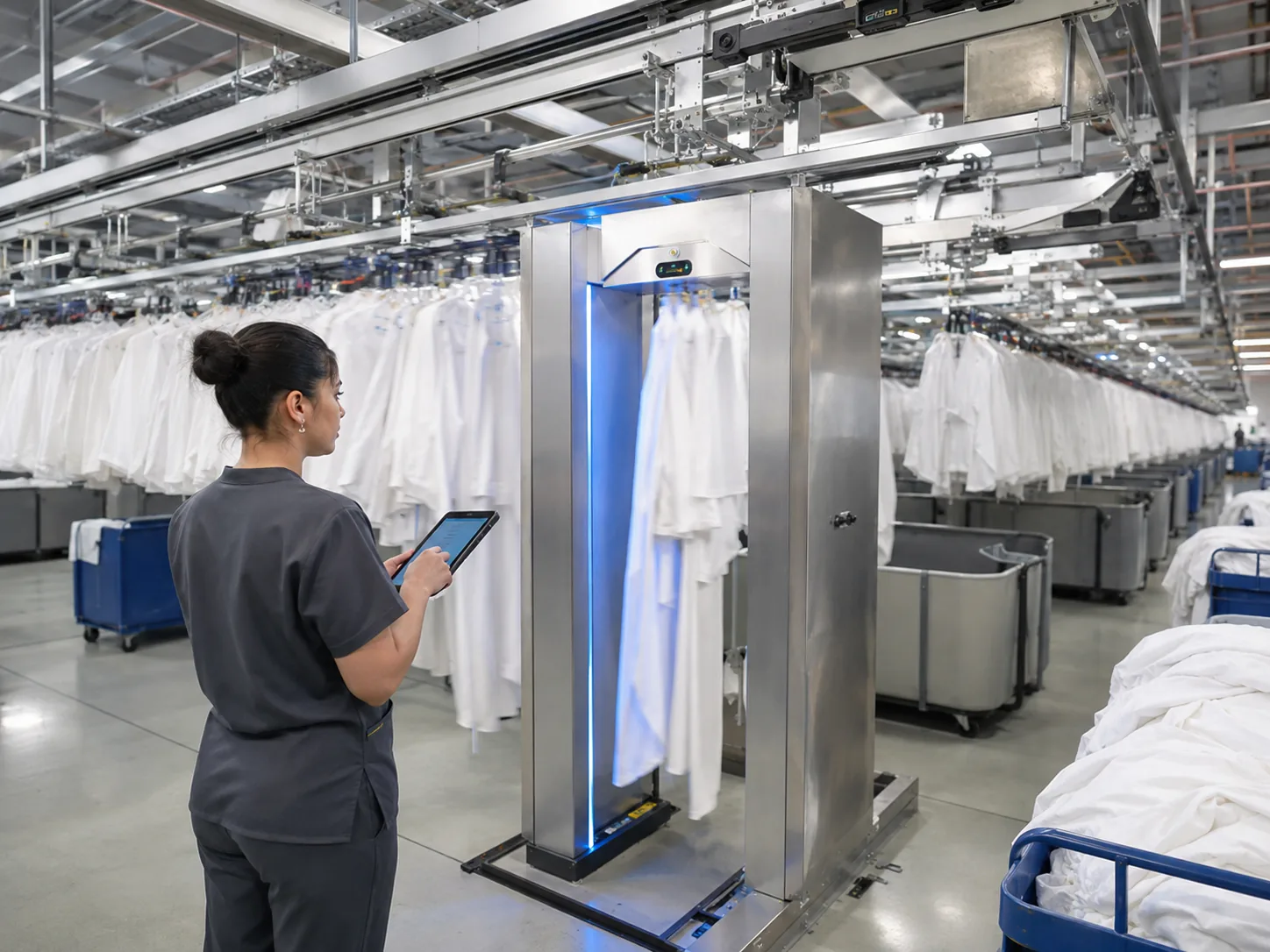
Read points belong where textiles change hands or where a decision is made. In most laundries the key stations are intake, drying and folding, plus dispatch. Ask the provider to explain each read point by the information it delivers.
8. Gate or portal, and what is the trade-off?
A gate is cheaper and faster, a portal costs more but encloses the load and reads more accurately. A provider should explain which one fits which point in your plant, and why.
9. How are returns counted at our customers?
Returns are counted where textiles are handed back: at a fixed drop box at the customer or a movable cabinet on the delivery truck. Anything counted only once it is back at the laundry is intake, and the losses on the way stay invisible.
Questions about software and cooperation
10. What will we see in the software, and who sees what?
Ask for a look at the dashboard with views per role: item history, stock per customer, delay reports, proof of delivery and return, items lost, product lifetime. Our page on textile tracking software shows what this looks like.
11. How does the data get to our other systems?
If you need the data in billing or other systems, ask how it gets there and whether that is part of the standard or an add-on on request.
12. How does a pilot work, and what is measured?
Hardware is planned for the whole laundry, so read points fit together later. Only the tags start small: one customer or one product line at one site. Agree up front what the pilot measures, against which baseline.
Answers that should make you think twice
| What you hear | Why it is a warning sign |
|---|---|
| A complete quote before anyone has seen your laundry | The system is sized by catalogue, not by your process |
| RFID is the answer to every problem you name | Nobody has checked whether a simpler fix would do |
| Tags are chosen from a datasheet, no test in your wash programs | Failures show up after rollout, not before |
| Returns are only counted back at the laundry | Losses on the way and at the customer stay invisible |
| Readers everywhere, without a reason per read point | Cost without information |
| No baseline before the pilot | Nobody can say later what changed |
If you want to go through these questions for your laundry with us, use our enquiry form. Our pages on RFID laundry tracking and the RFID laundry management system show how we answer them.
FAQ
 FAQ
Questions about
choosing an RFID laundry system
What should I look for in an RFID laundry system?
A provider who starts with your process, tests tags in your wash programs, places read points where the data is useful, counts returns at the customer site and shows the software per role before you decide.
Do we need RFID in the whole laundry from day one?
No. Hardware is planned for the whole laundry so the read points fit together, but the tags start small: one customer or one product line at one site. Some laundries start with the software or with fewer read points.
Which read points does a laundry need?
In most laundries the key stations are intake, drying and folding, plus dispatch and the return points at the customer site. The right set follows from your flows and the information you need.
Should we choose a gate or a portal?
A gate is cheaper and faster, a portal costs more but encloses the load and reads more accurately. Many laundries use both, at different points.
How do we compare RFID providers?
Ask each one the same questions about your process, tag tests, read points, returns, software and pilot, and compare the answers against your baseline rather than against feature lists.
When is RFID not the right choice?
When the problem is a routine rather than missing data, or when single items are handled at one spot. Then a changed process or a barcode can be the better answer.
Explore
More on RFID for laundries
Take the full system, or only the part you are missing. These pages go into each part and each industry.
- RFID laundry trackingHow tags, readers and software follow every textile through the laundry cycle, step by step.

- RFID laundry management systemDashboard, stock per customer, roles and integration: the software side of RFID in the laundry.
- RFID laundry tagsSaphire One: designed for 200 industrial wash cycles, sterilisation at 134 °C, sew-in or heat-seal.
- RFID linen trackingSheets, towels and table linen counted in bulk, with balances per customer for linen rental.
- Textile tracking softwareUse our software with tags and readers you already have, or as part of the full system.
- RFID for workwear and uniformsEvery garment linked to a wearer and a customer site, for uniform and workwear rental.
- RFID for healthcare laundriesHospital linen management with RFID: linen, scrubs and patient gowns per ward and hospital.
- Hotel linen trackingFor laundries serving hotels: see per property whether the planned stock of sheets and towels per room (the par level) is really there, with rental and hotel-owned linen kept apart.
- IndustriesWorkwear and uniform rental, healthcare, hospitality and linen rental: RFID by industry.
Blog
Related Blog
Technology
How to choose an RFID laundry tag: heat, chemistry, pressure and wash cycles
The questions that decide which RFID laundry tag fits your textiles: your hardest wash program, the extraction press, sterilisation, the format and position on the item, and how to test before you order.
Technology
RFID vs. barcode vs. camera in commercial laundries
RFID, barcode and camera systems answer different questions in a laundry. A decision matrix, the honest cases where a barcode is enough, and how to combine the options along the laundry cycle.

Operations
Laundry KPIs: the complete list for commercial laundries
Every KPI a commercial laundry needs, from pounds per operator hour and rewash rate to loss rate per customer, circulation time and linen par level, each with a definition, a formula and the role that owns it.