


Operations
Laundry KPIs for purchasing managers: wash cycles, lifetime and replacement
Purchasing manager KPIs in short
A purchasing manager in a laundry decides which textiles to buy, how many and when to replace them. The KPIs that matter most show how textiles actually wear and where they go: wash cycles per item, product lifetime, replacement rate, repair rate, items close to the end of their life, stock in circulation against what the contracts need and the share of purchases that replace lost rather than worn items. Without item-level data most of these are estimated from age and stocktakes. With a wash count per item they rest on actual use.
This article is part of our series on laundry KPIs by role. The definitions are the same in every article, so a loss that purchasing pays for is the same loss operations and sales see.
What the purchasing manager needs to know
- How long does each textile quality really last, in wash cycles and in time?
- Which items are due for replacement soon, and how many?
- How much of what we buy replaces worn items, and how much replaces lost ones?
- Is the stock in circulation in line with what the contracts need?
KPIs for the purchasing manager
| KPI | Definition | How to measure | Why it matters |
|---|---|---|---|
| Wash cycles per item | Number of completed industrial wash cycles recorded for one item. | Count each pass at a defined read point, for example the drying station; report the average and the spread per item type. | Replacement follows actual use instead of age or a stocktake estimate. |
| Product lifetime | Time and wash cycles from first use to retirement. | Date of first use, date of retirement and the wash count per item. | Shows how long each textile quality really lasts, so qualities can be compared on evidence. |
| Replacement rate | Items retired or lost in a period, as a share of the items in circulation. | Retirements recorded at sorting or the quality check, plus items flagged as lost, divided by the items in circulation. | The basis for purchase volumes and budgets per item type. |
| Repair rate | Items sent to repair, as a share of the items processed. | Repairs logged at sorting or at the quality check, per item type and customer. | Shows which textiles or customers drive repair cost, and when replacing makes more sense than repairing again. |
| Items near end of life | Items whose wash count or age is close to the planned lifetime of their type. | Wash count and age per item, compared with the planned lifetime per item type. | Turns replacement into a forecast instead of a surprise. |
| Replacement for loss vs. wear | Share of replacement purchases that replace lost items rather than worn ones. | Items flagged as lost compared with items retired for wear, per period and item type. | Shows how much of the purchase budget is spent on losses that could be reduced. |
| Stock in circulation vs. need | Items in circulation compared with the quantities all customer contracts require. | Item counts per customer and per stage, compared with the agreed quantities. | Shows how much textile capital is tied up beyond what customers pay for. |
The tag has a lifetime too. Saphire One is designed for 200 industrial wash cycles; our guide on how long RFID laundry tags last explains what decides it and how tag and textile lifetime fit together.
How to calculate the core KPIs
Purchasing KPIs work per item type, so each formula is calculated for sheets, towels or garments separately.
- Wash cycles per item = number of reads at the defined cycle point, for example the drying station
- Product lifetime = date of retirement − date of first use, together with the wash count at retirement
- Replacement rate (%) = (items retired + items lost) in the period ÷ items in circulation × 100
- Repair rate (%) = items sent to repair ÷ items processed × 100
- Loss share of replacements (%) = items replaced because they were lost ÷ all items replaced × 100
Which of these KPIs need item-level data
| KPI | Without item-level data | With item-level data (RFID) |
|---|---|---|
| Wash cycles per item | Estimated from age or planned cycles. | Counted per item. |
| Product lifetime | Estimated per batch or delivery. | Measured per item, from first use to retirement. |
| Replacement rate | From purchase records and stocktakes. | Per item type and customer, with the reason: lost or worn. |
| Repair rate | From repair records. | Per item, linked to its wash count. |
| Items near end of life | Not measurable. | From wash count and age per item. |
| Replacement for loss vs. wear | Rarely separable. | From items flagged as lost and items retired for wear. |
How purchasing managers work with these KPIs
- Compare textile qualities by lifetime in wash cycles, not by purchase price alone.
- Plan replacement purchases from the items near end of life, per item type.
- Bring the loss share of replacement purchases to operations and sales: it is the part of the budget that a process or contract change can reduce.
- Agree with suppliers when tags are attached. Tags are usually attached by the textile supplier, so new textiles arrive ready to be read.
From reads to figures
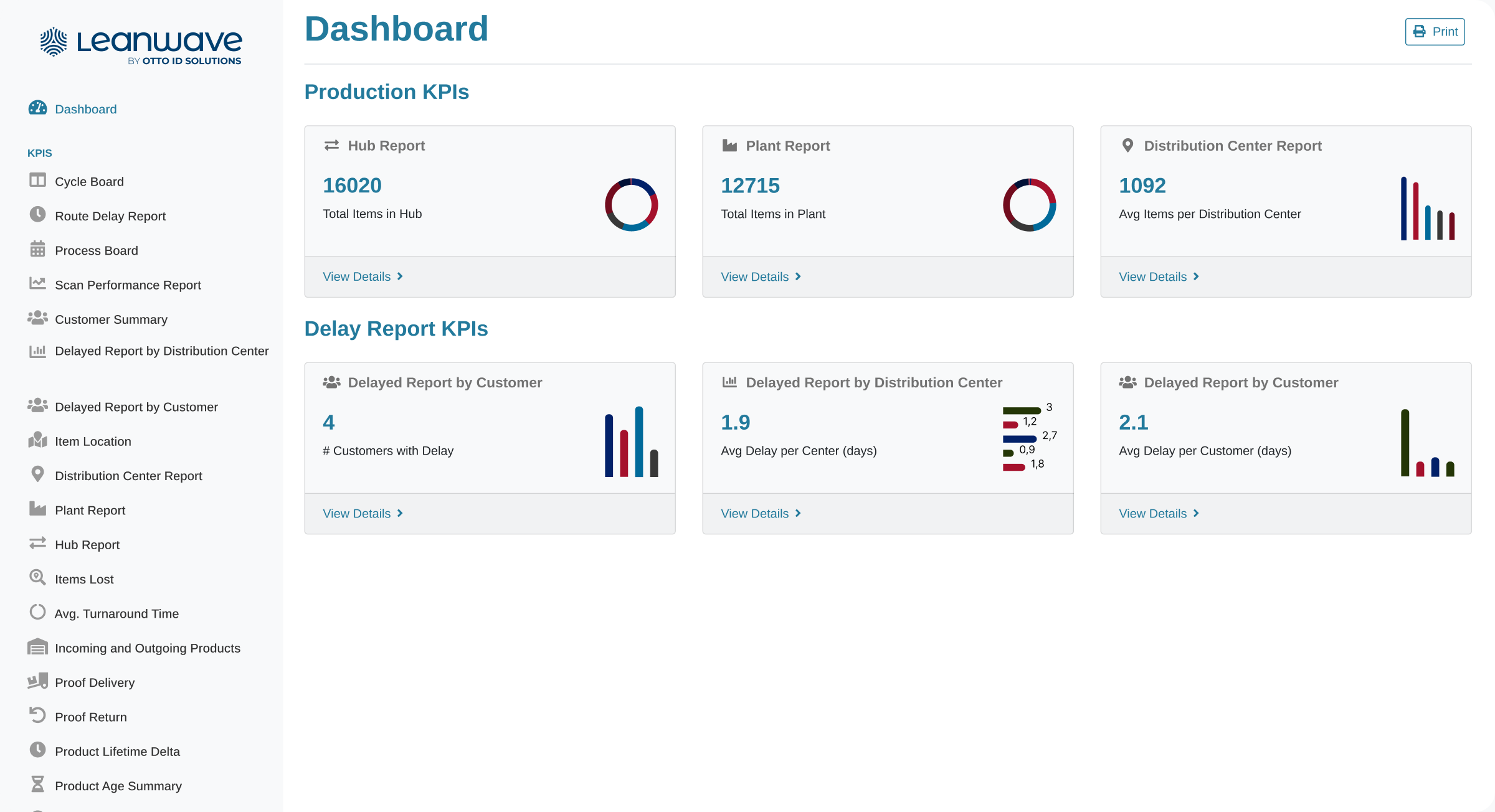
In the Leanwave dashboard, purchasing sees wash counts and age per item, so replacements are ordered on evidence. The product lifetime view shows how long textiles really last. Our page on RFID linen tracking shows how this works for linen pools.
KPIs for the other roles
Every role looks at the same textiles and the same reads, with the same definitions. All KPIs with formulas are in our overview of laundry KPIs. The other articles in this series cover:
- Operations manager: losses, circulation and stock along the whole cycle.
- Laundry manager: productivity, quality and throughput in the plant.
- Process manager: where items wait, fail or go missing between stations.
- Sales manager: what each customer holds, loses and costs.
- Customer success manager: deliveries, balances and complaints.
FAQ
 FAQ
Questions about
purchasing KPIs
Which KPIs should a laundry purchasing manager track?
Wash cycles per item, product lifetime, replacement rate, repair rate, items near the end of their life, the share of replacements caused by loss rather than wear, and stock in circulation against what the contracts need.
How do you count wash cycles per item?
Each item is read at a defined point in every cycle, usually the drying station, and each read adds one cycle to its history. Without item-level data, wash cycles are estimated from the age of the item or the planned number of cycles for its type.
How long do RFID laundry tags last?
Saphire One is designed for 200 industrial wash cycles. How long a tag lasts in practice depends on wash programs, heat, chemistry, pressure and how the textile is handled. Our guide on how long RFID laundry tags last covers the details.
Who attaches RFID tags to new textiles?
Usually the textile supplier, so new textiles arrive with the tag already in place and can be read from their first cycle. Tags that are missing or unreadable later are replaced at the quality check station in the laundry.
Explore
More on RFID for laundries
Take the full system, or only the part you are missing. These pages go into each part and each industry.
- RFID laundry trackingHow tags, readers and software follow every textile through the laundry cycle, step by step.

- RFID laundry management systemDashboard, stock per customer, roles and integration: the software side of RFID in the laundry.
- RFID laundry tagsSaphire One: designed for 200 industrial wash cycles, sterilisation at 134 °C, sew-in or heat-seal.
- RFID linen trackingSheets, towels and table linen counted in bulk, with balances per customer for linen rental.
- Textile tracking softwareUse our software with tags and readers you already have, or as part of the full system.
- RFID for workwear and uniformsEvery garment linked to a wearer and a customer site, for uniform and workwear rental.
- RFID for healthcare laundriesHospital linen management with RFID: linen, scrubs and patient gowns per ward and hospital.
- Hotel linen trackingFor laundries serving hotels: see per property whether the planned stock of sheets and towels per room (the par level) is really there, with rental and hotel-owned linen kept apart.
- IndustriesWorkwear and uniform rental, healthcare, hospitality and linen rental: RFID by industry.
Blog
Related Blog

Operations
Laundry KPIs for operations managers: losses, circulation and stock
The KPIs an operations manager in an industrial laundry needs to see where textiles leave the cycle, where they wait and whether each customer holds what was agreed, with definitions and how to measure them.
Operations
Laundry KPIs for sales managers: what each customer holds, loses and costs
The KPIs a sales manager in a laundry needs for customer meetings and contract renewals: customer balance, loss rate and loss charges per customer, textile cost per customer, stock against par level and delivery accuracy.
Technology
How long do RFID laundry tags last? Wash cycles, heat and pressure explained
Laundry tag life is counted in wash cycles, not years. What wears a tag out, from heat and chemistry to the extraction press, finishing and attachment, and how to test it in your own process.