


Technology
UHF vs. HF RFID for laundry tags
The short answer
A laundry tag needs to work throughout the entire process, from intake to dispatch. For automatic bulk textile tracking, Leanwave recommends passive UHF RFID. It identifies many tagged textiles over several metres, supporting reads in carts, bags and on conveyors. The same UHF tag also supports individual-item checks with suitable readers. HF RFID generally operates over shorter distances and can identify multiple tags, but UHF's combination of bulk reading and longer range makes it the better fit for the laundry workflows we design.
How HF and UHF RFID work
The laundry tags compared here are passive: they have no battery and receive their operating energy from the reader. The difference lies in how that energy reaches the tag.
HF: near field, short range
High frequency (HF) RFID works at 13.56 MHz, the same frequency as NFC. Reader and tag are coupled through a magnetic field, like the two coils of a transformer. That field weakens quickly with distance, so the tag has to be close to the antenna. HF generally operates over shorter distances than UHF. It supports controlled reading zones and can identify multiple tags within the antenna's field.
UHF: far field, longer range
Ultra high frequency (UHF) RFID uses frequencies in the range of about 860 to 960 MHz, and each region permits its own band within it. The reader sends out a radio wave; the tag reflects part of it back, modulated with its identity. Because this works with a travelling wave rather than a magnetic field close to the antenna, the range is measured in metres, and the reader can address many tags in quick succession. Saphire One reads at up to 12 m, based on EECC free-air testing under FCC conditions. Actual read range depends on reader setup, tag orientation, textile arrangement and operating environment.
There is also low frequency (LF) RFID, at around 125 kHz. It reads at very short range and is mostly found in access control and animal identification rather than in laundries.
UHF vs. HF RFID at a glance
| HF RFID | UHF RFID | |
|---|---|---|
| Frequency | 13.56 MHz | About 860 to 960 MHz, with regional bands within it. Saphire One covers 860 to 928 MHz. |
| Coupling | Near field (magnetic) | Far field (radio wave) |
| Read range | Shorter distances, close to the antenna | Several metres. Saphire One reads at up to 12 m, based on EECC free-air testing under FCC conditions. Actual read range depends on reader setup, tag orientation, textile arrangement and operating environment. |
| Bulk reading | Multiple-tag reading supported; practical capacity depends on the reader, antenna and load. | Well suited to automatic bulk identification of textiles in bags, carts and on conveyors. |
| Line of sight | Not needed | Not needed |
| Sensitivity to water | Generally less affected by water | Moisture can absorb UHF energy, so performance is tested with representative textiles and moisture levels |
| Sensitivity to metal | Affected when the tag sits on or near metal | Metal nearby can reflect or block signals; antenna placement and shielding are planned |
| Typical laundry use | Close-range identification, established in some laundry installations | Automatic bulk tracking from intake to dispatch, with individual-item checks using the same tag |
| Reading stations | Desktop pads and other close-range antennas, NFC-capable devices | Tunnels, portals, read stations and cabinets |
| Planning effort | Antenna coverage and textile presentation need planning. | Read zones, antenna placement and unwanted reads need planning. |
Why bulk reading matters in a laundry
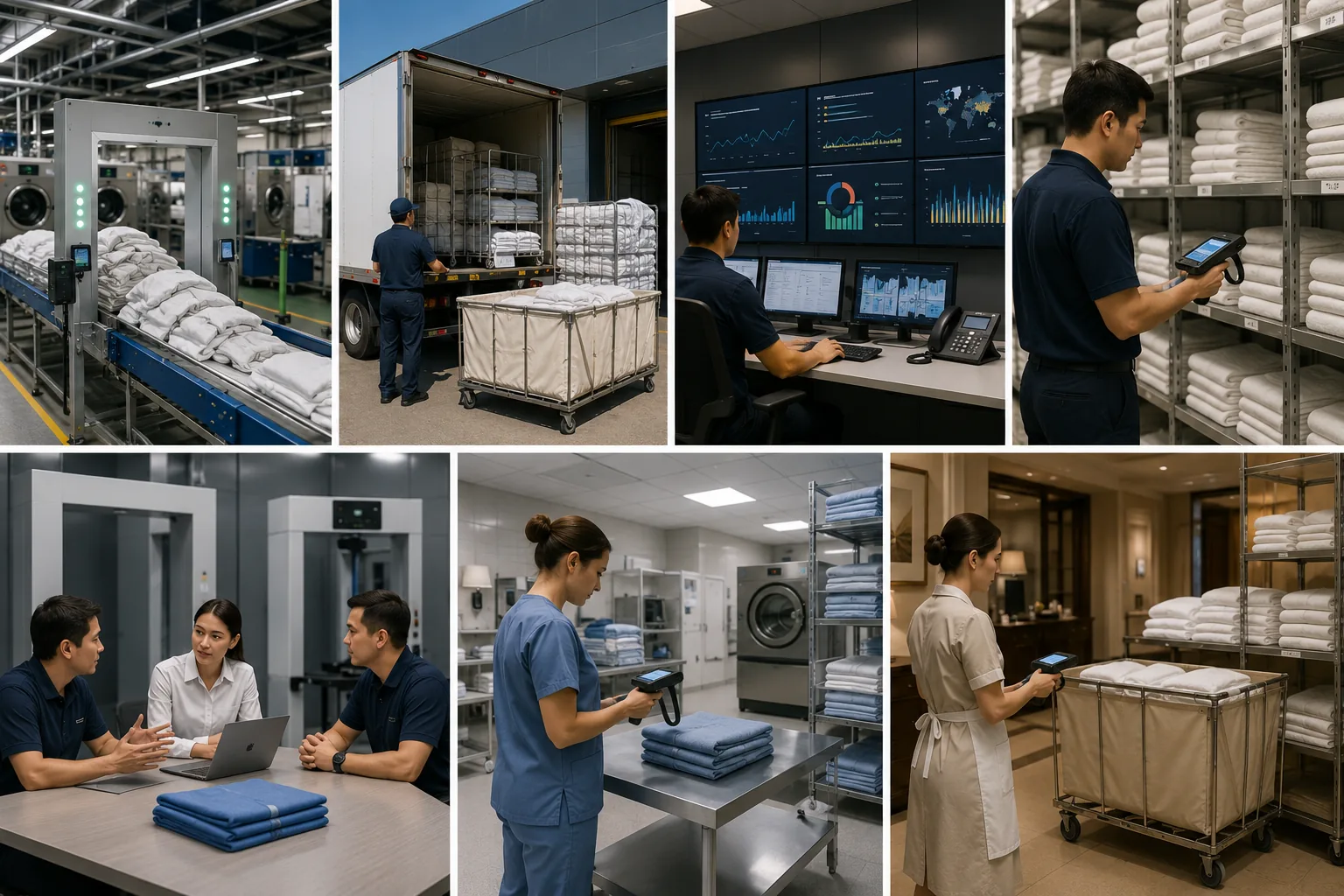
At intake and dispatch, textiles often move in carts, bags and cages. Reading each item individually adds handling and can slow the workflow. UHF RFID supports automatic bulk identification at these points, with reading performance verified for the actual textiles, load sizes and equipment.
Linking item-level reads across the laundry cycle supports stock balances per customer, circulation times, recorded wash cycles and the investigation of textile losses. Reliable results require suitable reading stations and software that connects each reading event to the relevant customer and process stage.
Water, metal and the laundry environment
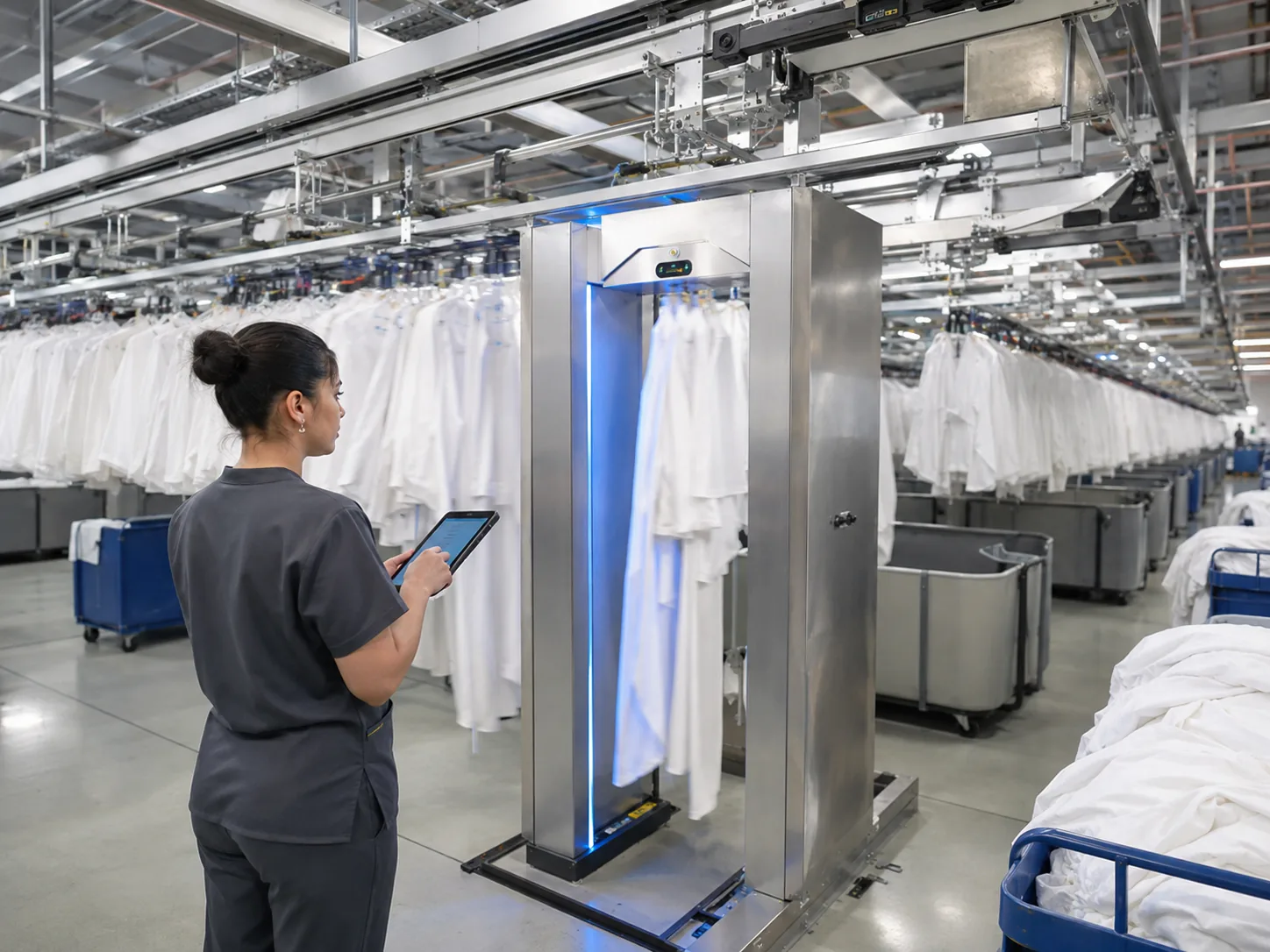
Water and metal influence how an RFID reading station performs. Moisture can absorb UHF radio energy and affect the tag antenna, while densely packed textiles can make reliable identification more difficult. Performance must therefore be tested with representative textiles, load sizes and moisture levels.
Metal carts, machines and racks can reflect or block UHF signals. Antenna placement, reader settings and shielding help define the reading zone and reduce unwanted reads, for example preventing a dispatch station from registering textiles in a nearby cart. More reading range is not always better.
HF is generally less affected by water, but this does not mean a laundry needs a different tag technology for wet-area checks. Leanwave designs the UHF reading stations around the complete workflow and validates each station under actual operating conditions. Pilot testing establishes which configuration achieves the required performance and whether changes to textile presentation or handling are needed.
Why Leanwave recommends UHF throughout the laundry process
Textiles pass through different handling conditions during a laundry cycle, but their identification should remain consistent. Leanwave recommends using passive UHF RFID throughout the workflow, with reading stations configured for the requirements of intake, processing, stocktaking and dispatch.
UHF supports both automatic bulk identification and individual-item checks. A repair station or quality-control table therefore does not require a switch to HF simply because the textile is handled individually. Suitable UHF antennas and reader settings can provide a controlled reading zone while keeping the same tag and textile record across the operation.
HF remains an established identification technology, including in some laundry installations. For the automatic bulk tracking workflows Leanwave designs, however, UHF provides the reading range and flexibility needed across the complete process.
Saphire One and the Leanwave system
Saphire One is a UHF laundry tag covering 860 to 928 MHz. It is designed for 200 industrial wash cycles, 60 bar in the extraction press and sterilisation at 134 °C, and is certified to OEKO-TEX Standard 100, product class I. It comes as a sew-in tag (70 × 10 mm) or a heat-seal tag (72 × 12 mm), both 1.6 mm thick, and reads at up to 12 m, based on EECC free-air testing under FCC conditions. Actual read range depends on reader setup, tag orientation, textile arrangement and operating environment. For specialised requirements there are the GENX2 Tag, the Gamma Tag and the MRI Tag. The Saphire One RFID laundry tags page has the full details.
For laundries planning automatic bulk identification from intake to dispatch, Leanwave recommends UHF RFID. Its longer reading range supports the same tag across multiple reading stations throughout the laundry process. Leanwave supplies the complete RFID laundry system or only the components you need: RFID laundry tags, reader infrastructure and the Leanwave dashboard. If you already have compatible tags and readers, you can use our textile tracking software with your existing hardware. You can also start with three key reading stations instead of installing all six stations: intake, drying and folding. Our pages on RFID laundry tracking and the RFID laundry management system explain how the reading stations and software work together.
FAQ
 FAQ
Questions about
UHF and HF RFID
What is the difference between UHF and HF RFID?
HF RFID works at 13.56 MHz and couples reader and tag through a magnetic field close to the antenna, so it generally operates over shorter distances and supports controlled reading zones. UHF RFID works at about 860 to 960 MHz and communicates by radio wave, so it reads over several metres and is well suited to automatic bulk identification. HF is generally less affected by water. For automatic bulk textile tracking throughout the laundry process, Leanwave recommends UHF.
Is UHF or HF better for laundry tags?
For automatic bulk textile tracking throughout the laundry process, Leanwave recommends passive UHF RFID. The same tag supports identification from intake to dispatch, including processing, stocktaking and individual-item checks. Each reading station is configured for its task, so close-range checks do not require switching to HF. HF can support laundry applications, but UHF's longer reading range and suitability for bulk identification make it the better fit for the workflows we design.
Can UHF laundry tags be read when textiles are wet?
Yes. Moisture can absorb UHF radio energy and affect the tag antenna, and densely packed textiles can make reliable identification more difficult. That is why each reading station is tested with representative textiles, load sizes and moisture levels and validated under actual operating conditions. Wet-area checks do not require a different tag technology.
Can a smartphone read UHF laundry tags?
Yes, with a compatible external UHF reader or reader attachment and a suitable app. The smartphone's built-in NFC hardware cannot read UHF laundry tags. Basic attachments can support testing and occasional checks; rugged reader attachments and dedicated UHF handhelds are available for daily industrial use.
Which frequency does Saphire One use?
Saphire One operates in the UHF frequency range of 860 to 928 MHz. The reader must operate within the locally permitted frequency band. The tag supports ISO/IEC 18000-6C / EPC Class 1 Gen 2.
Can a laundry move from HF to UHF tags?
Yes. Existing textiles can remain in circulation and receive UHF tags during a phased transition. The laundry needs UHF-compatible readers and a plan for linking the new tags to textile records in its software. Existing HF readers cannot read UHF tags, so the transition must cover all required reading stations across the workflow.
Explore
More on RFID for laundries
Take the full system, or only the part you are missing. These pages go into each part and each industry.
- RFID laundry trackingHow tags, readers and software follow every textile through the laundry cycle, step by step.

- RFID laundry management systemDashboard, stock per customer, roles and integration: the software side of RFID in the laundry.
- RFID laundry tagsSaphire One: designed for 200 industrial wash cycles, sterilisation at 134 °C, sew-in or heat-seal.
- RFID linen trackingSheets, towels and table linen counted in bulk, with balances per customer for linen rental.
- Textile tracking softwareUse our software with tags and readers you already have, or as part of the full system.
Blog