


Operations
Laundry KPIs for customer success managers: deliveries, balances and complaints
Customer success manager KPIs in short
A customer success manager in a laundry is where a missing item turns into a complaint. The KPIs that matter most let the team see a problem before the customer does: delivery accuracy, on-time delivery, stock against the agreed par level, items not yet returned per customer, complaints per customer and topic, and the time it takes to resolve them. With item-level data, each of these comes with the list of items behind it, so an answer to a customer is a record rather than an estimate.
This article is part of our series on laundry KPIs by role. The definitions are the same in every article, so customer success, sales and operations talk about the same figures.
What the customer success manager needs to know
- Did each customer get what was ordered, on time?
- Does each customer hold what the contract says, or is a shortage building up?
- Which items have left and not come back, per customer?
- When a customer complains, can we answer with a record?
KPIs for the customer success manager
| KPI | Definition | How to measure | Why it matters |
|---|---|---|---|
| Delivery accuracy | Share of deliveries in which the quantity per item type matches the order or the par level. | The dispatch read per cart or bag, compared with the order. | The KPI the customer notices first. |
| On-time delivery | Share of deliveries that leave by the agreed time. | Dispatch time compared with the delivery schedule. | Reliability as the customer experiences it. |
| Stock against par level | Items a customer holds per item type, compared with the quantity agreed in the contract. | Delivered minus returned per item type, from dispatch and return reads. | Shortages and surplus become visible before they cause a complaint. |
| Items not yet returned per customer | Items that have left dispatch for a customer and have not come back yet, per item type. | Items with a dispatch read and no return or intake read since. | You see what is still at the customer, item by item, instead of a total nobody can check. |
| Complaints per customer and topic | Complaints logged per customer and period, grouped by topic such as quantity, quality or timing. | The complaint log, linked to the deliveries concerned. | Shows recurring problems per customer and which team owns them. |
| Time to resolve | Average time from a complaint to an answer the customer accepts. | The complaint log, from first contact to closing. | With a delivery record at hand, most quantity questions can be answered at once. |
How to calculate the core KPIs
Customer success KPIs are calculated per customer, so each account can be followed on its own.
- Delivery accuracy (%) = deliveries matching the order per item type ÷ all deliveries × 100
- On-time delivery (%) = deliveries leaving by the agreed time ÷ all deliveries × 100
- Stock against par level = items delivered − items returned − linen par level, per item type
- Items not yet returned = items with a dispatch read and no return or intake read since
- Time to resolve = average time from the first contact about a complaint to its closing
Which of these KPIs need item-level data
| KPI | Without item-level data | With item-level data (RFID) |
|---|---|---|
| Delivery accuracy | From packing lists and checks by hand. | From the dispatch read per cart or bag. |
| On-time delivery | From dispatch times. | The same, plus which items were missing. |
| Stock against par level | From delivery notes and counts by hand. | From dispatch and return reads per item type. |
| Items not yet returned | A total from delivery notes. | A list of items with their dispatch read and no read since. |
| Complaints per customer | From the complaint log. | The same, with the delivery record behind each complaint. |
| Time to resolve | From the complaint log. | Shorter, because the record is already there. |
For customer success, the difference is the record behind each figure. With a dispatch read per cart or bag and return reads per item type, a question from a customer is answered with the delivery record instead of an estimate.
How customer success managers work with these KPIs
- Watch stock against par level and items not yet returned per customer every week, and call the customer before a shortage turns into a complaint.
- Answer quantity questions with the delivery record per cart or bag, not with a recount.
- Group complaints by topic and hand recurring ones to the team that owns them: quantity to operations, quality to the laundry manager.
- Share the customer balance with sales before each customer meeting, so both teams use the same figures.
From reads to figures
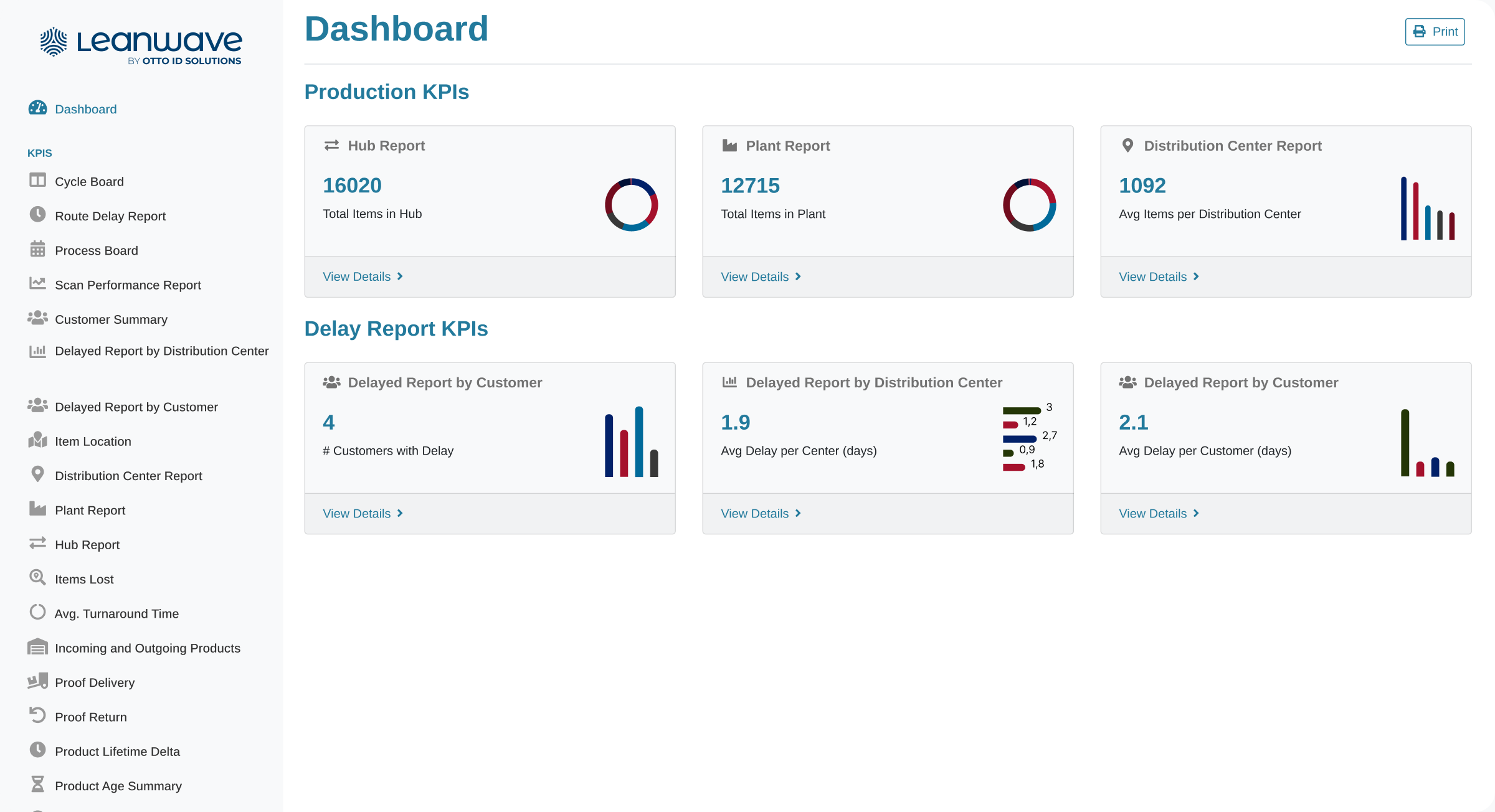
In the Leanwave dashboard, customer success sees a customer summary with balances and delivery records, and proof of delivery and return shows what went out and what came back per customer. Our pages on RFID linen tracking and on the RFID laundry management system explain how these records come about. If you want to talk it through, use the enquiry form.
KPIs for the other roles
Every role looks at the same textiles and the same reads, with the same definitions. All KPIs with formulas are in our overview of laundry KPIs. The other articles in this series cover:
- Operations manager: losses, circulation and stock along the whole cycle.
- Laundry manager: productivity, quality and throughput in the plant.
- Process manager: where items wait, fail or go missing between stations.
- Purchasing manager: wash cycles, product lifetime and replacement.
- Sales manager: what each customer holds, loses and costs.
FAQ
 FAQ
Questions about
customer success KPIs
Which KPIs should a laundry customer success manager track?
Delivery accuracy, on-time delivery, stock against par level, items not yet returned per customer, complaints per customer and topic, and time to resolve. Together they show problems before the customer reports them and give a record to answer with when they do.
How do you measure delivery accuracy in a laundry?
Compare the quantity per item type in each delivery with the order or the par level, and count the share of deliveries that match. With RFID, the dispatch read per cart or bag records what actually left, so the check no longer depends on packing lists and counts by hand.
Where are returns read in an RFID laundry set-up?
At the customer site, for example with a drop box or a read cabinet on the delivery truck. Everything counted once the textiles are in the laundry is recorded as intake.
How do you check a linen par level?
Compare what a customer holds per item type with the par level agreed in the contract. What the customer holds is the items delivered minus the items returned. With dispatch and return reads per item, the comparison is a record rather than a count by hand, so a shortage shows before the customer calls.
How does item-level data help with customer complaints?
When a customer reports a shortage, the delivery record shows which items went out in which cart or bag, and the return reads show what came back. Most quantity questions can be answered from that record at once, without a recount.
Explore
More on RFID for laundries
Take the full system, or only the part you are missing. These pages go into each part and each industry.
- RFID laundry trackingHow tags, readers and software follow every textile through the laundry cycle, step by step.

- RFID laundry management systemDashboard, stock per customer, roles and integration: the software side of RFID in the laundry.
- RFID laundry tagsSaphire One: designed for 200 industrial wash cycles, sterilisation at 134 °C, sew-in or heat-seal.
- RFID linen trackingSheets, towels and table linen counted in bulk, with balances per customer for linen rental.
- Textile tracking softwareUse our software with tags and readers you already have, or as part of the full system.
- RFID for workwear and uniformsEvery garment linked to a wearer and a customer site, for uniform and workwear rental.
- RFID for healthcare laundriesHospital linen management with RFID: linen, scrubs and patient gowns per ward and hospital.
- Hotel linen trackingFor laundries serving hotels: see per property whether the planned stock of sheets and towels per room (the par level) is really there, with rental and hotel-owned linen kept apart.
- IndustriesWorkwear and uniform rental, healthcare, hospitality and linen rental: RFID by industry.
Blog
Related Blog

Operations
Laundry KPIs for sales managers: what each customer holds, loses and costs
The KPIs a sales manager in a laundry needs for customer meetings and contract renewals: customer balance, loss rate and loss charges per customer, textile cost per customer, stock against par level and delivery accuracy.

Operations
Laundry KPIs for operations managers: losses, circulation and stock
The KPIs an operations manager in an industrial laundry needs to see where textiles leave the cycle, where they wait and whether each customer holds what was agreed, with definitions and how to measure them.
Insights
How RFID works in uniform rental programs
How RFID links each garment to a wearer and a customer site in uniform and workwear rental, which read points a program needs, what changes for the laundry and its customers, and how to roll it out.