


Technology
How long do RFID laundry tags last? Wash cycles, heat and pressure explained
The quick answer
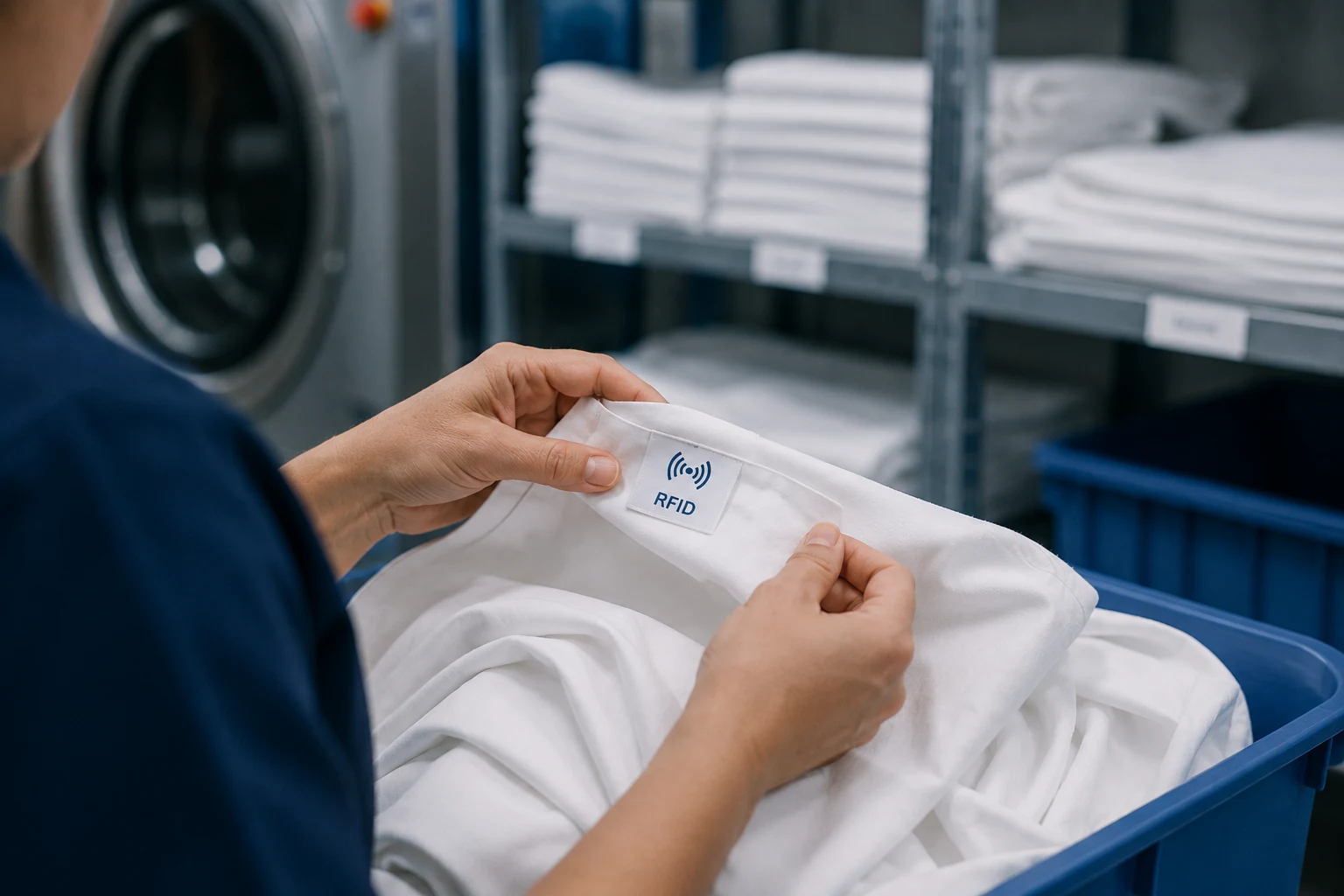
Laundry tag life is measured in wash cycles, not years. An RFID laundry tag ages each time it goes through washing, water extraction, drying and finishing, so a tag in a textile that is washed every day reaches the end of its life far sooner in calendar terms than the same tag in a textile washed once a month. Our Saphire One tag is designed for 200 industrial wash cycles. How many cycles a tag actually reaches in your laundry depends on six factors: temperature, chemistry, pressure in the extraction press, ironing and finishing, the way the tag is attached, and how the textile is handled.
This guide goes through each factor, explains what you can control, and shows how to check tag life in your own wash programs before you commit to a rollout.
One thing a laundry tag does not do is run flat. A passive UHF tag has no battery: the reader supplies the energy and the tag answers with its ID. So the question is not when the power runs out, but when heat, pressure, chemistry or handling stop the tag from answering, or separate it from the textile it identifies.
Why wash cycles are the right measure
A tag in a laundry does not wear out sitting on a shelf. It wears out in the process. Every cycle exposes it to the same sequence of heat, water, chemistry and mechanical load, and any damage comes from that sequence repeated. Counting cycles therefore tells you far more about the remaining life of a tag than counting months.
In practice we state the life of a tag as 200 wash cycles or two years, because two years is roughly what it takes a textile in regular use to reach 200 washes.
It also makes tag life comparable with the life of the textile. Laundries already plan the replacement of sheets, towels and garments by use and wear. A tag rated in wash cycles fits the same logic, and the question to ask is simple: will the tag last as long as the textile it is in?
To translate cycles into calendar time for your own operation, divide the rated wash cycles by the number of times an item is washed per month. The result is the calendar life of the tag in that textile group, as long as the process stays within the tag specification. Workwear on a weekly rotation, hotel linen changed daily and healthcare garments washed after every shift give three different answers for the same tag.
| Input | Where it comes from | What it tells you |
|---|---|---|
| Rated wash cycles | The tag specification; Saphire One is designed for 200 industrial wash cycles | The planning value under specified conditions |
| Washes per item per month | Your rotation per textile group, or the wash counts from your RFID system once it runs | How fast an item uses up its cycles |
| Expected calendar life | Rated wash cycles divided by washes per item per month | When tags in that group are due, if the process stays within specification |
| Planned textile life | Your own replacement planning per textile type | Whether tag and textile reach the end of their life at a similar time |
The wash count is also where item-level tracking pays off. Once the system runs, every item carries its own count, and you no longer have to estimate how often a textile group circulates.
Temperature and chemistry
Heat is the first factor most laundries think of, and rightly so. Wash temperatures, thermal disinfection programs and the heat in dryers and finishers all load the tag, and the load adds up over many cycles. A tag that is specified for your hottest process will last longer than one that is regularly pushed to its limit.
In healthcare, sterilisation adds a further step. Saphire One withstands sterilisation at 134 °C. For other requirements we also offer specialised tags, including the Gamma Tag and the MRI Tag; ask us which one fits your process.
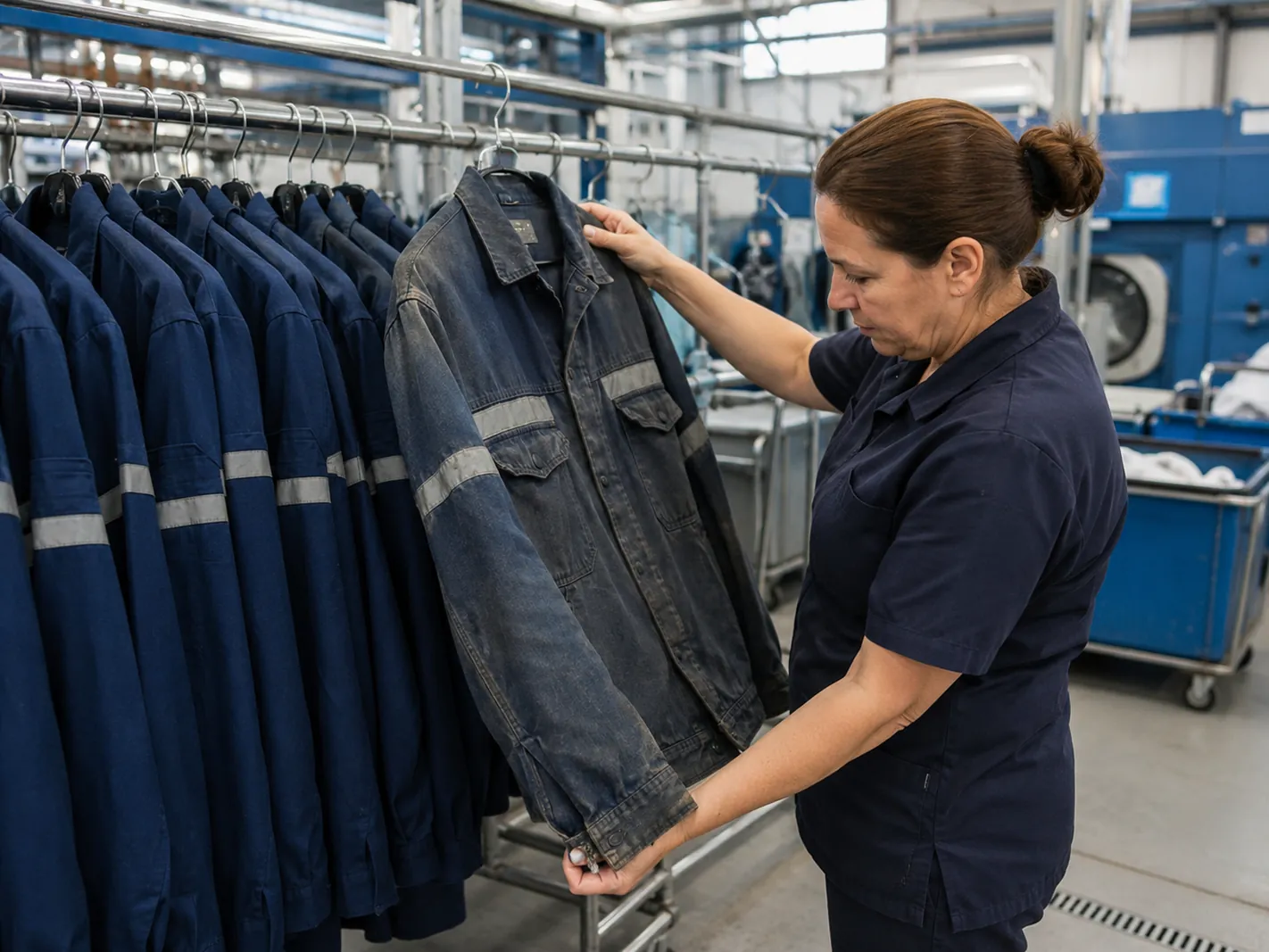
Chemistry matters as much as heat. Industrial detergents, alkaline main washes, bleaching and oxidising agents, neutralisers and finishing agents all act on the tag and on the way it is fixed to the fabric. The combination of high temperature and aggressive chemistry is harder on a tag than either on its own. If you run a particularly aggressive program, for example for heavily soiled workwear, test tags in exactly that program.
Saphire One is certified to OEKO-TEX Standard 100, product class I. That certification concerns harmful substances, which matters for textiles worn next to the skin. It is a separate question from how long a tag lasts in your chemistry, and both should be checked.
Pressure in the extraction press
In a tunnel washer line, the load leaves the wash and goes into an extraction press that squeezes the water out under high pressure. For a tag this is one of the hardest moments in the cycle. The full weight of a wet load is pressed onto it, and any hard object nearby, such as a button, a zip or a buckle, can concentrate that pressure on one spot.
Saphire One is specified for 60 bar in the extraction press. If your press runs within that value, pressure is a planned load, not a risk. If you are not sure what pressure your press applies, find out before the tag test, because it is one of the settings that most clearly separates a tag that lasts from one that does not.
Laundries that remove water by spinning rather than pressing load the tag differently, through centrifugal force and the tumbling of the load. Here too, a test in your own machines gives the answer.
Position helps in both cases. A tag placed in a flat, soft area of the textile takes the load more evenly than one sitting under a button placket or in a stiff hem. Textile suppliers often sew thick seams further into the textile, which leaves room for the tag.
Drying, ironing and finishing
After extraction, textiles go into tumble dryers, through flatwork ironers, or through tunnel finishers and garment presses. Each step adds heat, and ironers and presses add contact pressure as well. Flatwork is particularly demanding, because a sheet or tablecloth passes between heated surfaces with the tag inside the fabric.
On linen the tag sits at the side or in a corner, never in the middle. On garments it can sit in a seam, but usually it goes on the back label. Saphire One withstands the heat of the ironer, so a tag inside the textile can go through the ironer as it is.
Dryers are rarely the critical step on their own, but heat combined with mechanical tumbling over many cycles adds to the total load. Long drying times and high dryer temperatures add to it further.
Attachment: where tag life is often decided
A tag that still works but has come off the textile is as lost as a broken one. In practice the attachment is often the first thing to fail, which is why we treat it as part of the system design and not as an afterthought.
Saphire One comes in two formats: a sew-in tag of 70 × 10 mm and a heat-seal tag of 72 × 12 mm, both 1.6 mm thick. It can also be placed in a textile pouch attached to the item. Each method has its strengths and its own way of failing.
| Method | Suits | Watch out for |
|---|---|---|
| Sew-in | Garments, workwear and items that go through finishing tunnels and repairs | Sewing over the antenna, which breaks the connection and cuts readability; a tag that the textile supplier folds or fits the wrong way is defective from the start |
| Heat-seal | Flatwork and textiles where a seam is unwanted; fast tagging with a heat press | A seal that was not pressed correctly can fail over time, so press settings and training matter |
| Pouch | Items where the tag should be easy to fit or replace | The pouch itself has to survive the cycle and stay closed |
Heat-sealing is fast, but it depends on the right temperature, pressure and time at the press, and on a fabric the seal bonds to. A badly sealed tag can look fine on day one and come loose after a number of cycles. Sewing is slower and does not depend on press settings, but it carries its own risk: if the supplier does not follow the attachment process, a folded tag or a seam over the antenna makes the tag useless. Which method fits depends on the textile, the position on the item and your production setup, and it is worth testing both on your own textiles.
Formats and attachment options are described in detail on our page on Saphire One RFID laundry tags.
Handling and the life of the textile
Not every tag that disappears fails in a machine. Tags are cut out by wearers who find them uncomfortable, or lost with the textile when it is turned into a rag or thrown away. Some textiles also leave the cycle long before their tag would have worn out.
Three habits reduce these losses. Place tags where wearers do not feel them and where repairs do not touch them. Brief your sewing room on how to work around a tag. And retire tagged textiles at the end of their life through a defined step, so the system knows the item is gone rather than counting it as lost.
How a tag is handled at tagging matters too. A tag that is bent sharply, caught by a needle or overheated during sealing starts its life damaged, even if it still reads at first.
How to recognise a failing tag
In a running RFID system, a tag that has stopped answering does not raise an alarm by itself. It simply stops appearing. The software can make that visible: if an item that should be in a cart is not read at intake, or an item read at intake is not read at folding, the system flags it for a manual check. For example, if a batch of five pieces passes the folding station and only four are read, the fifth tag may be weak or defective, and the piece goes to the quality check station.
That check tells you whether the item is missing its tag, whether the tag is defective, or whether it was a false negative caused by the proximity effect, when tags packed closely together are not read. Re-tagging happens at the quality check station right after folding; at sorting an item can only be flagged. A re-tagged item keeps its history, because the link between tag and item lives in the software, not on the tag. Over time, these exceptions also show which textile groups and programs are hardest on tags.
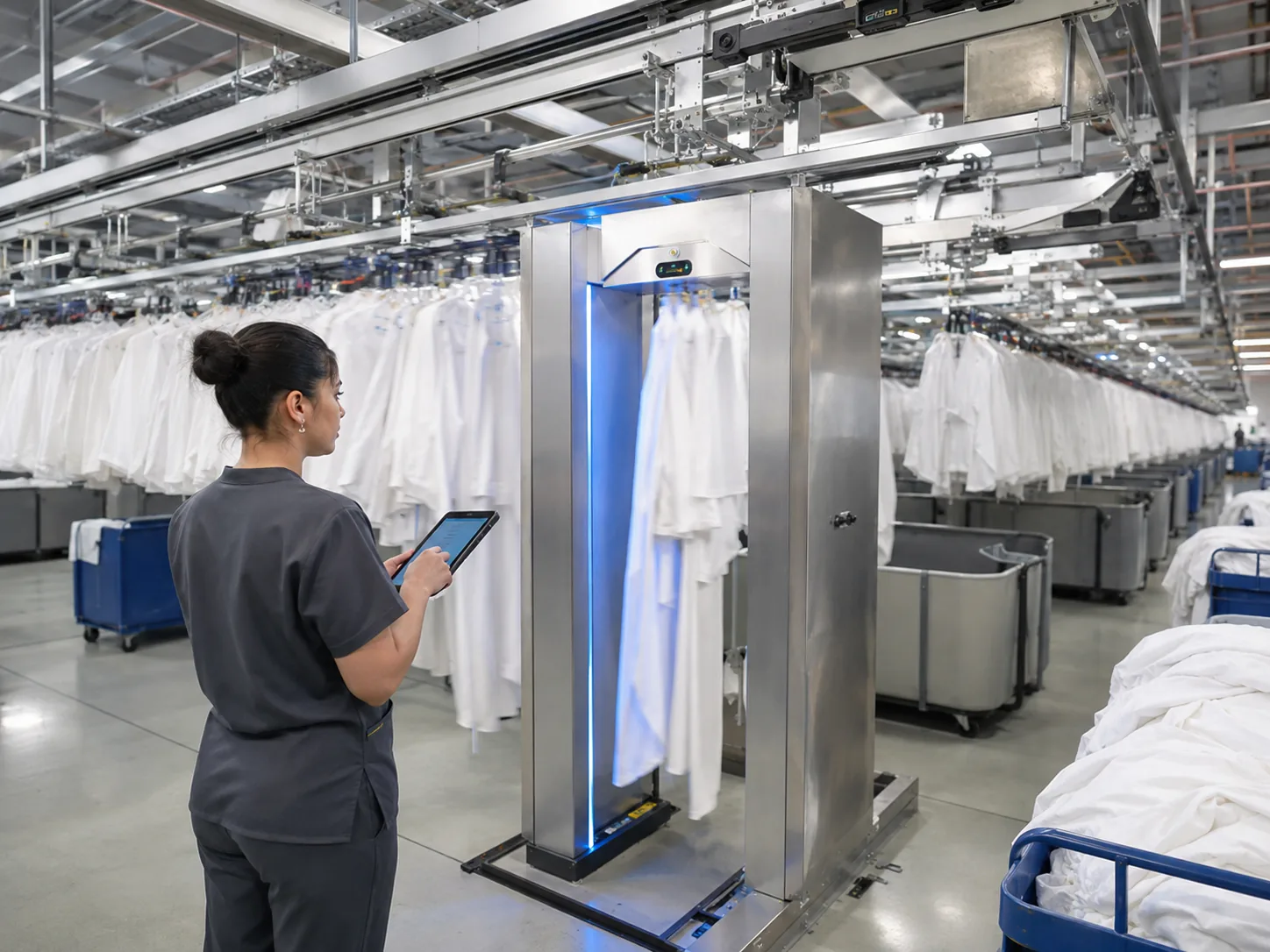
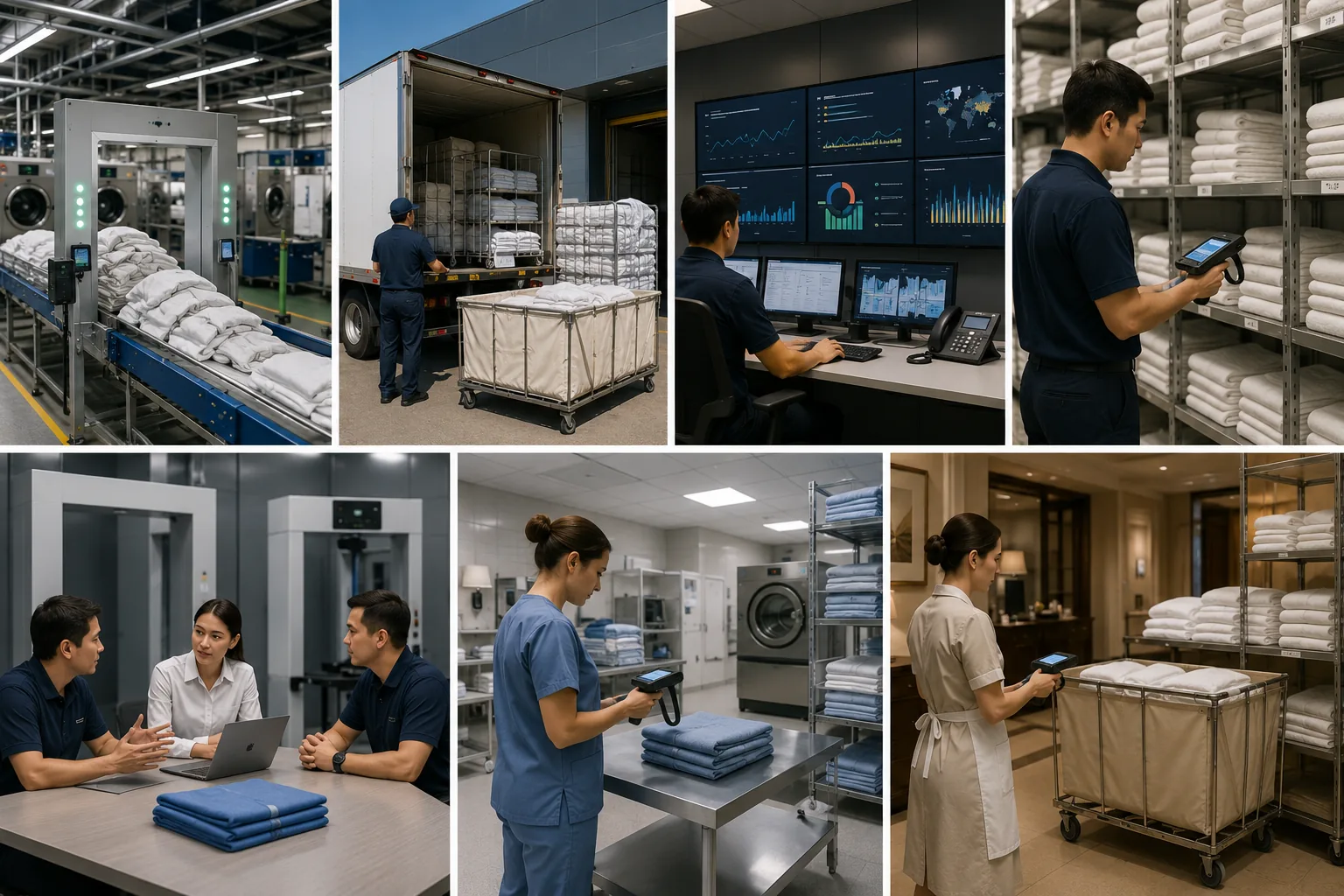
This is one reason read points matter as much as the tag. With the three key stations, intake, drying and folding, an item is seen several times per cycle, and a tag problem surfaces within one cycle instead of at the next stocktake. The three stations also give you redundancy: a tag that is missed at one station is usually read at another, and that corrects the data. If a tag is not read at intake, it first looks missing; when it is read at drying or folding, you know it was there all along. Our page on RFID laundry tracking shows where these read points sit along the laundry cycle.
Testing tag life in your own laundry
Specifications describe tested conditions. Your laundry has its own. The reliable way to know how long tags will last in your process is to run them through it before you roll out.
- Pick the textile groups with the hardest treatment: the hottest programs, the most aggressive chemistry, the heaviest finishing.
- Tag a sample of each group with the attachment method you intend to use, and record the tagging conditions.
- Run the samples through your normal process and read them at fixed points, so every cycle is counted.
- Check them at regular intervals for read performance, attachment and visible damage, and note when and where any fail.
- Compare the results with your planned textile life before you decide on tag and attachment.
Request samples of Saphire One through our enquiry form. We help you set up the test, and if you already have tags or readers, we work with them: Leanwave offers the full system or individual parts, from our software on its own to three key stations instead of all six.
FAQ
 FAQ
Questions about
RFID tag lifespan
How long do RFID laundry tags last?
Laundry RFID tags are rated in wash cycles rather than years, because they age through processing, not through time. Saphire One is designed for 200 industrial wash cycles. How many cycles a tag reaches in practice depends on temperature, chemistry, the pressure in the extraction press, ironing and finishing, the attachment and how the textile is handled. To convert cycles into calendar time, divide the rated cycles by the number of washes per item per month.
Do RFID laundry tags need a battery?
No. Laundry tags are passive UHF tags: they have no battery and take the energy they need from the reader's signal. There is no battery to run down, so a tag used within its specification keeps working until heat, pressure, chemistry or handling damage it, or separate it from the textile.
Can RFID tags survive high wash temperatures and sterilisation?
Tags made for industrial laundries are designed for it, within their specification. Saphire One withstands industrial washing and sterilisation at 134 °C, and it is specified for 60 bar in the extraction press. For other requirements we offer specialised tags, including the Gamma Tag and the MRI Tag. If your process differs from these conditions, test tags in your own programs before rollout.
What is the most common reason a laundry tag stops working?
Often it is not the tag but the attachment or the handling: a heat seal that was not pressed correctly, a seam that wears through, or a tag cut out by a wearer. Process conditions beyond the specification of the tag are the other main cause. Both can be reduced by choosing the right attachment and position for each textile type and by testing in your own process.
Does the extraction press damage RFID tags?
It can, if the pressure exceeds what the tag is specified for, or if the tag sits under a hard trim such as a button or zip that concentrates the load. Saphire One is specified for 60 bar in the extraction press. Placing the tag in a flat, soft part of the textile helps it take the load evenly.
How do we notice when a tag has failed?
A failed tag simply stops being read. With read points at intake, drying and folding, the software can flag an item that was expected in a load but not read, and a manual check shows whether the item is missing, its tag has failed, or it was a false negative caused by the proximity effect. The item can then be re-tagged at the quality check station after folding and keeps its history, because the link between tag and item is held in the software.
Should the tag last as long as the textile?
Ideally, yes, so nobody has to re-tag an item during its life. Compare the rated wash cycles of the tag with your planned textile life per group. Where a textile is expected to outlive its tag, plan a re-tagging step at the quality check station after folding, rather than letting items drop out of the system.
Can we test tags before we decide?
Yes, and we recommend it. Request samples of Saphire One through our enquiry form. Run them through your hardest programs with the attachment you plan to use, read them at fixed points and check them at regular intervals. The result is a tag life you have measured in your own process rather than a figure from someone else's.
Explore
More on RFID for laundries
Take the full system, or only the part you are missing. These pages go into each part and each industry.
- RFID laundry trackingHow tags, readers and software follow every textile through the laundry cycle, step by step.

- RFID laundry management systemDashboard, stock per customer, roles and integration: the software side of RFID in the laundry.
- RFID laundry tagsSaphire One: designed for 200 industrial wash cycles, sterilisation at 134 °C, sew-in or heat-seal.
- RFID linen trackingSheets, towels and table linen counted in bulk, with balances per customer for linen rental.
- Textile tracking softwareUse our software with tags and readers you already have, or as part of the full system.
- IndustriesWorkwear and uniform rental, healthcare, hospitality and linen rental: RFID by industry.
Blog
Related Blog
Technology
RFID vs. barcode vs. camera in commercial laundries
RFID, barcode and camera systems answer different questions in a laundry. A decision matrix, the honest cases where a barcode is enough, and how to combine the options along the laundry cycle.
Technology
UHF vs. HF RFID for laundry tags
How UHF and HF RFID differ in reading range, bulk identification and performance around water and metal, and why Leanwave recommends passive UHF RFID for tracking textiles throughout the laundry process, from intake to dispatch.