


Operations
Laundry KPIs for process managers: where items wait, fail and go missing
Process manager KPIs in short
A process manager in a laundry looks at the steps between intake and dispatch and asks where items wait, where they fail and where they go missing. The KPIs that matter most are measured per step: internal loss per step, dwell time per step, first-pass quality, sorting errors, re-tagging rate and read coverage per station. Almost all of them need item-level data, because they compare what one station saw with what the next station saw. That is the core of RFID laundry tracking: every item is read at fixed points, so each step has an input and an output.
This article is part of our series on laundry KPIs by role. The definitions are the same in every article, so a gap the process manager finds is the same gap operations and the laundry manager see.
What the process manager needs to know
- At which step do items leave the cycle?
- Where do items wait longer than they should?
- Which step produces the most rework?
- Does each read point see the items it should see?
KPIs for the process manager
| KPI | Definition | How to measure | Why it matters |
|---|---|---|---|
| Internal loss rate per step | Items read at one station and not read at the next, as a share of the items that entered the step. | Compare the reads of consecutive stations, for example intake, drying and folding. | Points corrective action at the step where items leave the cycle. |
| Dwell time per step | Average time between the read at one station and the read at the next. | Time between consecutive reads per item, per step and item type. | Shows where items wait, which is where queues and later losses start. |
| First-pass quality | Share of items that pass the quality check the first time. | Items passing the quality check without a reject, per item type and customer. | The mirror image of the rewash rate, measured where the process can still change. |
| Sorting error rate | Items sorted into the wrong wash category, as a share of the items sorted. | Items flagged at the sorting read station, and items found in the wrong category later. | Wrong categories cost a wash and can damage textiles before anyone notices. |
| Re-tagging rate | Items whose tag is missing or unreadable and is replaced at the quality check station right after folding, as a share of the items processed. | Items flagged at sorting or another station and re-tagged at the quality check station. | An item without a readable tag has no history; a rising rate shows where tags are damaged or badly placed. |
| Read coverage per station | Share of the items expected at a station that were actually read there. | Items read at the station before and after, compared with the items read at the station itself. | A station that misses items creates gaps that look like losses. |
Re-tagging is a process step of its own: sorting only flags an item, and the new tag is attached at the quality check station right after folding. Our guide on how to choose an RFID laundry tag covers tag position, which decides how often re-tagging is needed.
How to calculate the core KPIs
Process KPIs are measured per step, so each formula compares one station with the next.
- Internal loss rate per step (%) = (items read at one station − items read at the next) ÷ items read at the first station × 100
- Dwell time per step = average time between the read at one station and the read at the next, per item type
- First-pass quality (%) = items passing the quality check the first time ÷ items checked × 100
- Re-tagging rate (%) = items re-tagged at the quality check station ÷ items processed × 100
- Read coverage per station (%) = items read at the station ÷ items read at the stations before and after it × 100
Which of these KPIs need item-level data
| KPI | Without item-level data | With item-level data (RFID) |
|---|---|---|
| Internal loss rate per step | Not measurable. | From the difference between the reads of consecutive stations. |
| Dwell time per step | Estimated by observation. | Measured per item and step. |
| First-pass quality | As a total from quality records. | Per item, customer and item type. |
| Sorting error rate | Found by chance, later in the process. | Flagged at the sorting read station. |
| Re-tagging rate | Not applicable. | Counted at the quality check station. |
| Read coverage per station | Not applicable. | From the reads before, at and after the station. |
How process managers work with these KPIs
- Look at one step at a time: input, output, dwell time and rework.
- Check read coverage before you call a gap a loss. A station that misses items and a step that loses items look the same in a total.
- Change one thing at a time and compare against the baseline of the same step.
- Start with the three key stations, intake, drying and folding. Drying gives the most time to read every tag, which makes it the most reliable read point and the redundancy point.
From reads to figures
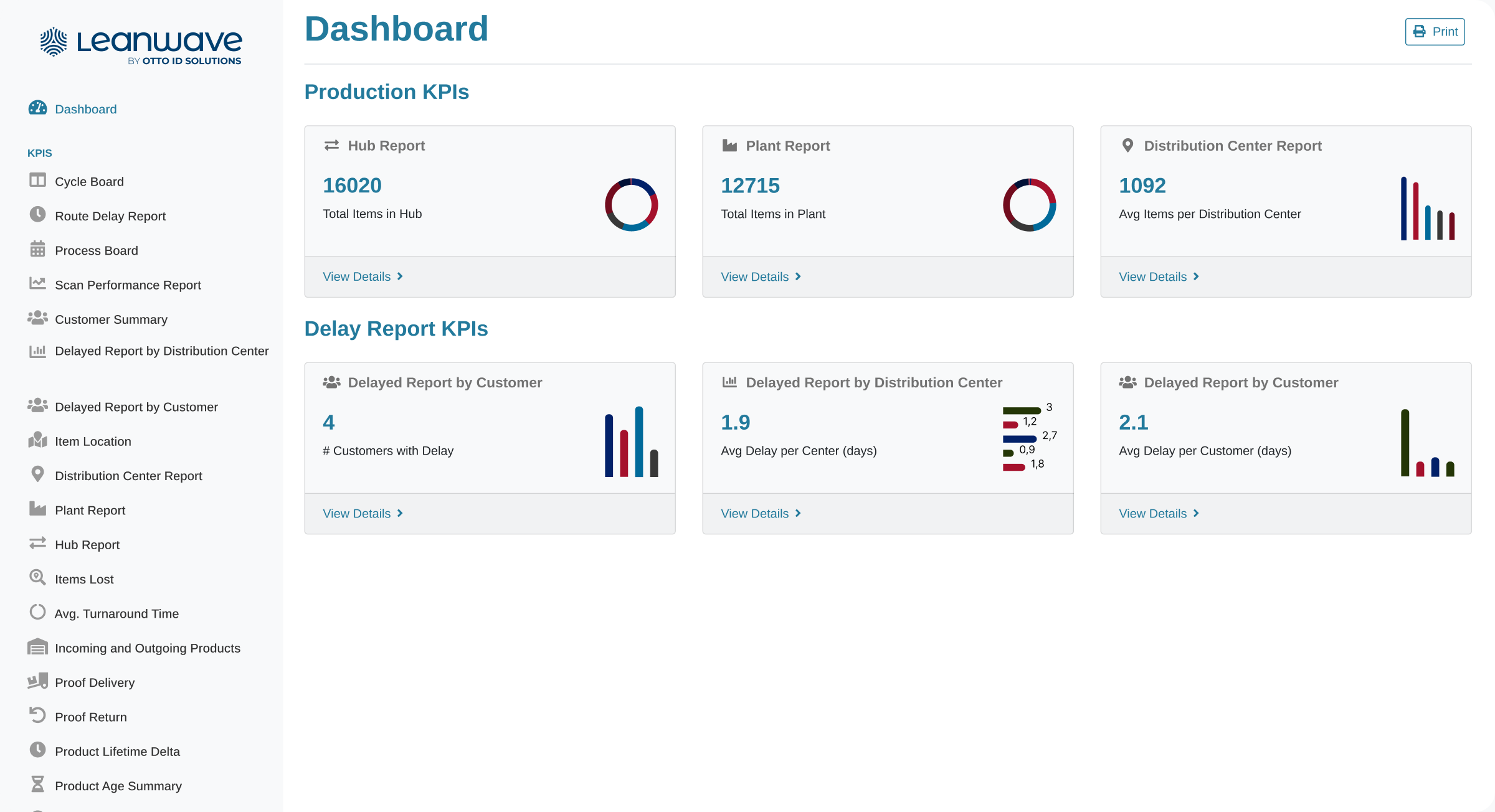
The Leanwave dashboard shows which items left the cycle and at which step, and the process board shows where work queues up. Every figure goes back to the item history, so a gap can be traced to the items behind it. The read stations along the cycle are described on our page on RFID laundry tracking, and the hardware at each point on our page on RFID gates and portals.
KPIs for the other roles
Every role looks at the same textiles and the same reads, with the same definitions. All KPIs with formulas are in our overview of laundry KPIs. The other articles in this series cover:
- Operations manager: losses, circulation and stock along the whole cycle.
- Laundry manager: productivity, quality and throughput in the plant.
- Purchasing manager: wash cycles, product lifetime and replacement.
- Sales manager: what each customer holds, loses and costs.
- Customer success manager: deliveries, balances and complaints.
FAQ
 FAQ
Questions about
process KPIs
Which KPIs should a laundry process manager track?
Internal loss rate per step, dwell time per step, first-pass quality, sorting error rate, re-tagging rate and read coverage per station. They show where items leave the cycle, where they wait and where rework starts, one step at a time.
How do you find the step where items go missing?
Compare the items read at one station with the items read at the next. Items that entered a step and were not read at the end of it either left the cycle there or were missed by the read point. Checking the read coverage of the station first separates the two.
Where are RFID laundry tags replaced?
At the quality check station right after folding. Sorting only flags an item whose tag is missing or unreadable; the new tag is attached once the item is clean, dry and folded.
Which read point is the most reliable in a laundry?
The drying station. Drying gives far more time to read every tag than a quick pass through a portal, without extra handling. That makes it the most reliable read point in the plant and the redundancy point for the stations before and after it.
Explore
More on RFID for laundries
Take the full system, or only the part you are missing. These pages go into each part and each industry.
- RFID laundry trackingHow tags, readers and software follow every textile through the laundry cycle, step by step.

- RFID laundry management systemDashboard, stock per customer, roles and integration: the software side of RFID in the laundry.
- RFID laundry tagsSaphire One: designed for 200 industrial wash cycles, sterilisation at 134 °C, sew-in or heat-seal.
- RFID linen trackingSheets, towels and table linen counted in bulk, with balances per customer for linen rental.
- Textile tracking softwareUse our software with tags and readers you already have, or as part of the full system.
- RFID for workwear and uniformsEvery garment linked to a wearer and a customer site, for uniform and workwear rental.
- RFID for healthcare laundriesHospital linen management with RFID: linen, scrubs and patient gowns per ward and hospital.
- Hotel linen trackingFor laundries serving hotels: see per property whether the planned stock of sheets and towels per room (the par level) is really there, with rental and hotel-owned linen kept apart.
- IndustriesWorkwear and uniform rental, healthcare, hospitality and linen rental: RFID by industry.
Blog
Related Blog

Operations
Laundry KPIs for operations managers: losses, circulation and stock
The KPIs an operations manager in an industrial laundry needs to see where textiles leave the cycle, where they wait and whether each customer holds what was agreed, with definitions and how to measure them.
Operations
Commercial laundry KPIs for laundry managers: productivity, quality and throughput
The commercial laundry KPIs a laundry manager needs to run the plant: pounds per operator hour, labour cost per pound, rewash rate, throughput time, load and machine utilisation, work ready on time and what is waiting at each stage, with formulas.

Insights
Linen loss and linen inventory: where textiles disappear and how to measure it
Where sheets, towels and garments leave the cycle, from the laundry floor to the customer site, how to measure linen loss without a full stocktake, and which measures actually reduce it.