



Operations
Transparency: Operation Manager
The Situation
According to the contract, Laundry Business (X) delivers a total of 300 garments to 3 customers (relatively A, B, C), each receiving 100. On due date, each customer gives back an unknown number of garments. After the cleaning process at X’s end, the total amount only adds up to 280 pieces. Due to lack of transparency, it is nearly impossible to identify if, where nor how many garments might have been lost.
(Note: This use case is primarily intended for readers who are new to RFID technology or have not yet implemented an RFID solution. If you already have experience with RFID, you are welcome to continue reading if the topic is relevant to you, or proceed directly to the subsequent use cases)
The Operations Manager
An Operations Manager is responsible for ensuring that a company’s day-to-day operations run efficiently, reliably, and according to defined processes and standards. The Operations Manager oversees the end-to-end operational system, rather than managing only one laundry or the transport function.
I. The Damage
- Inability to identify the source of loss: Can not determine whether losses occurred at the customer, transport, laundry, sorting, storage, etc.
- Inability to assign operational responsibility: Without evidence of where the loss happened, Operations can not establish which process/location was responsible.
- Inability to implement targeted corrective actions: If the source of losses is unknown, Operations can not know which process needs to be changed.
- Unreliable inventory visibility: The system says 300 garments are in circulation, but only 280 are physically accounted for. Operations therefore lack a trustworthy view of actual inventory
- Need for higher operational buffers: Uncertainty forces the overall operation to tolerate additional inventory/safety stock to maintain service levels.
II. The Solution
a. Inability to identify the source of loss/Inability to assign operational responsibility:
- Information provided by RFID
At each station, a reading device is installed and by giving an ID to each garment, every time a garment passes through one of these stations they are read and counted.
Take the below picture as an example:
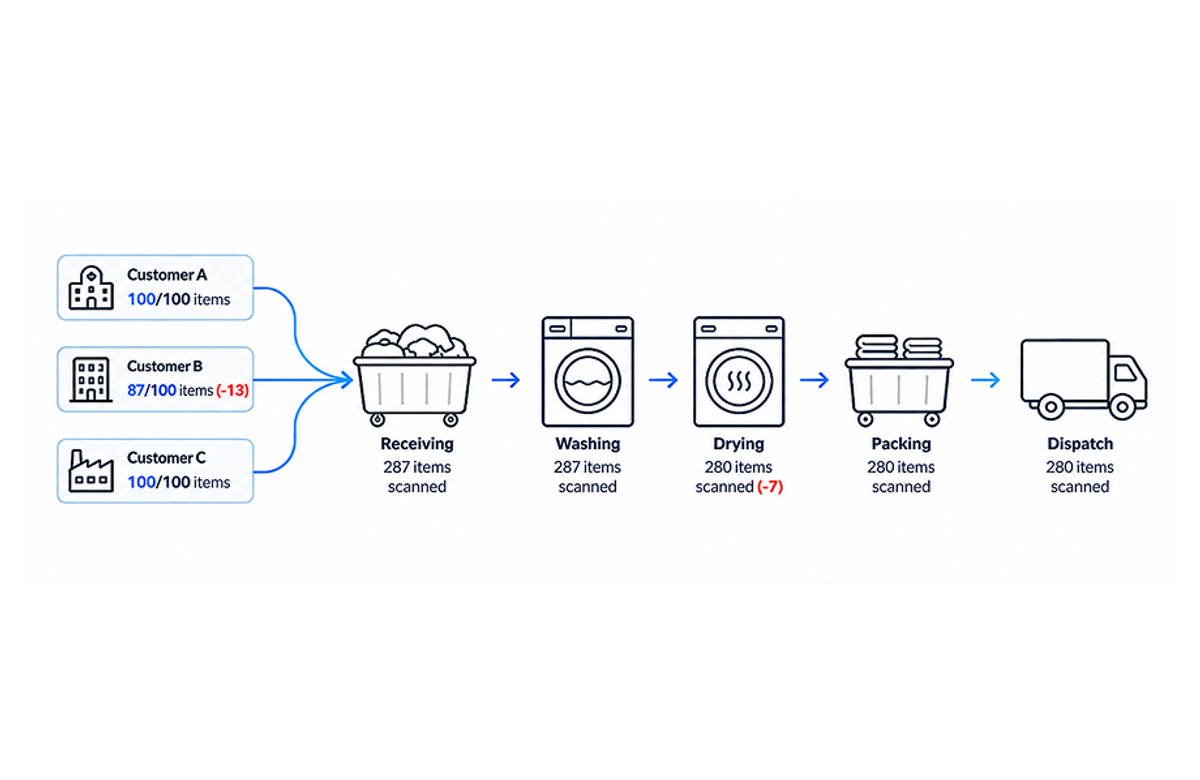
External loss: Customer A is delivered 100 and they returned 100 items so there is no unexplained loss, the same goes for customer C. For Customer B, the company delivered 100 items but only received 87 items, that means customer B is responsible for 13 items lost.
Internal loss: with 13 items lost externally, the total received amount is now only 287 out of 300. During the cleaning process, at drying station, the scanning device only recognised 280 items which means 7 less than the previous count.
- Usage of Information:
- With this level of transparency, the Operations Manager can accurately identify where a loss occurred. If the loss occurs at the customer’s site, the associated cost can be assigned and billed to the responsible customer in accordance with the contract. If the loss occurs internally, management can identify the responsible process area and implement targeted corrective measures.
- When the company manages multiple product types with different values, RFID enables losses to be identified at the individual-item level. Because each garment has a unique digital identity linked to information such as product type, customer, and value, the company can determine exactly which item was lost and the appropriate replacement cost to charge.
b. Inability to implement targeted corrective actions
- Information provided by RFID:
RFID enables real-time, item-level monitoring of garments throughout the laundry cycle, providing visibility into their current status, customer allocation, and delivery deadlines. Automated exception alerts allow the laundry to identify delayed or at-risk items early and take corrective action before service levels are affected.
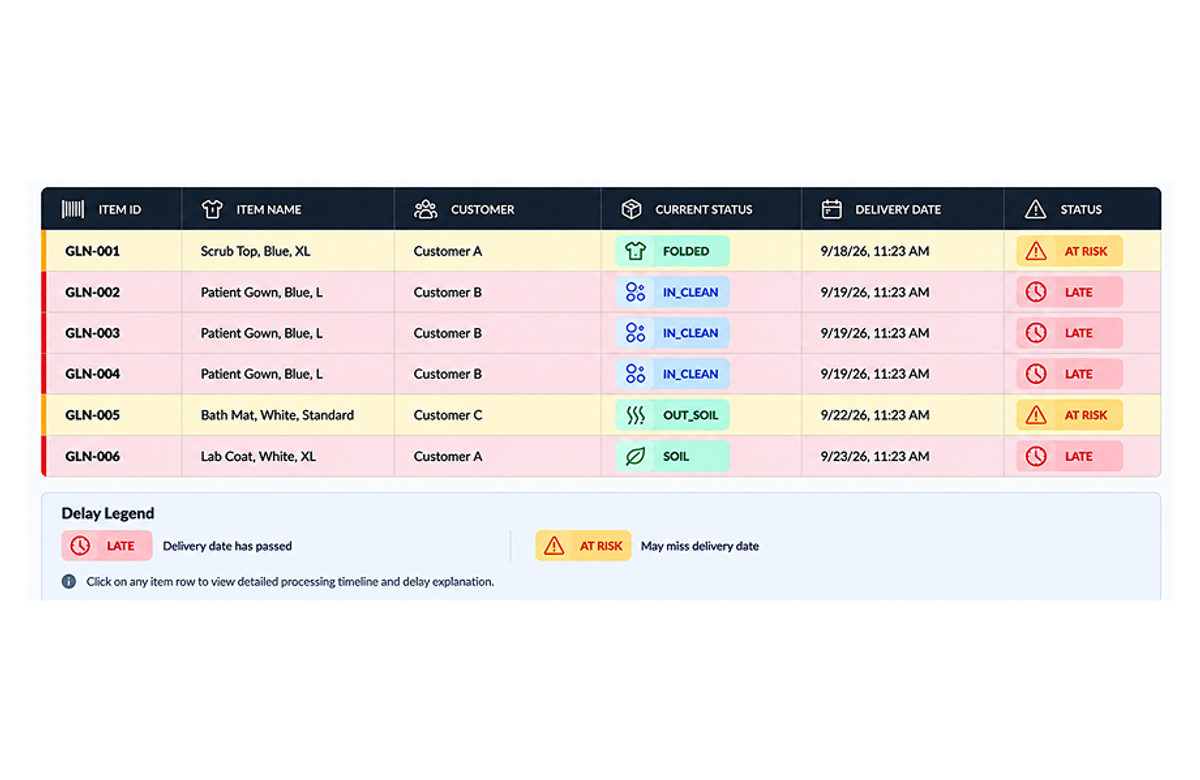
- RFID provides process-level transparency by measuring garment loss and delay rates across each stage of the laundry cycle. This enables management to identify operational bottlenecks, localise sources of loss, and implement targeted improvements based on measurable performance data
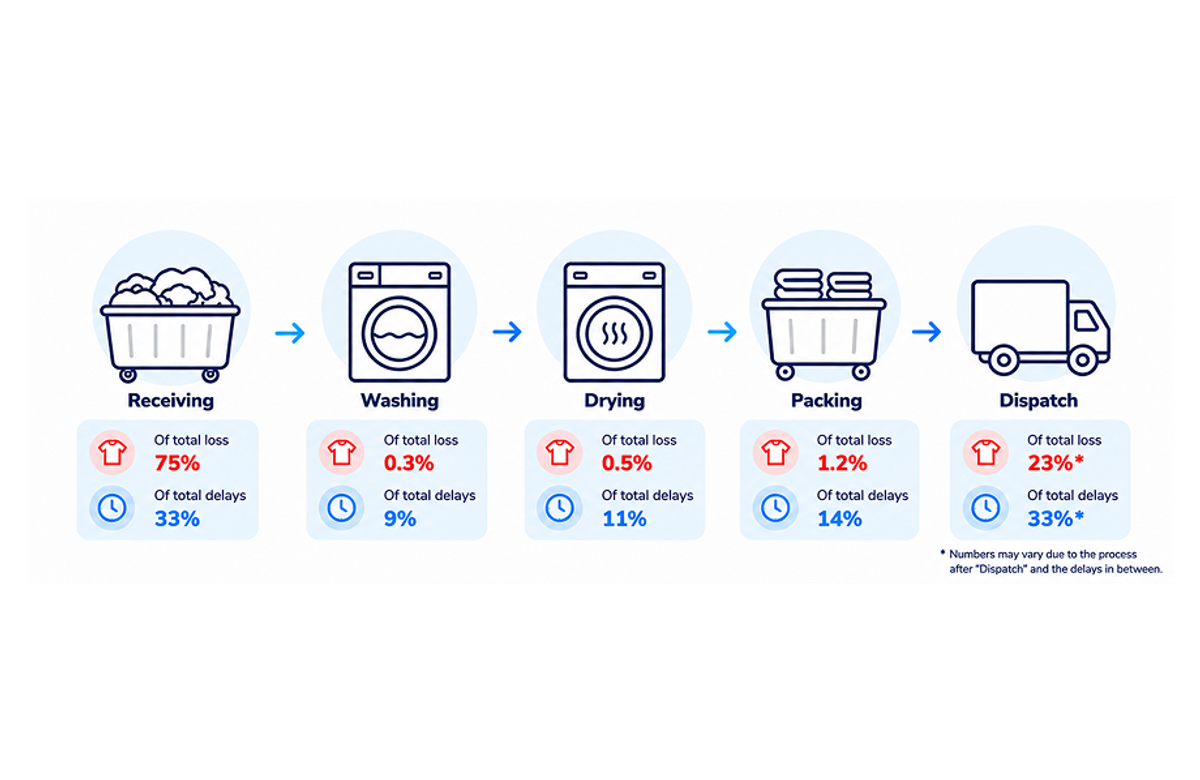
Real-life example:
If a laundry company is performing at a rate of 6% of the total textile are lost.
Respectively, the calculations would be:
- Receiving: 75% x 6% = 4.5%
- —> 4.5% of total textiles are lost at Receiving
- Washing: 0.3% x 6% = 0.018%
- —> 0.103% of total textiles are lost at Washing
- Drying: 0.5% x 6% = 0.03%
- —> 0.12% of total textiles are lost at Drying
- Packing: 1.2% x 6% = 0.072%
- —> 4.5% of total textiles are lost at Receiving
- Dispatch: 23% x 6% = 1.38%
- —> 0.103% of total textiles are lost at Washing
- Usage of information:
- By providing real-time visibility into item status, RFID enables the Operations Manager to take proactive action before delays impact service delivery. Items marked “At Risk” can be prioritised and operational resources adjusted to accelerate processing. If an item is already “Delayed,” the Operations Manager can quickly identify the issue and implement an alternative process, route, or recovery plan to minimise further disruption and maintain service levels.
- With this level of process-level visibility, the laundry company can identify underperforming stations and implement targeted corrective measures. In this example, the Drying Station records the highest loss and delay rates, highlighting it as a priority for investigation and improvement. Addressing the underlying causes can help reduce garment losses, minimise operational delays, improve process efficiency, and prevent future revenue leakage.
c. Unreliable inventory visibility
- Information provided by RFID:
- RFID gives the laundry business a real-time, item-level view of each customer’s textile inventory.
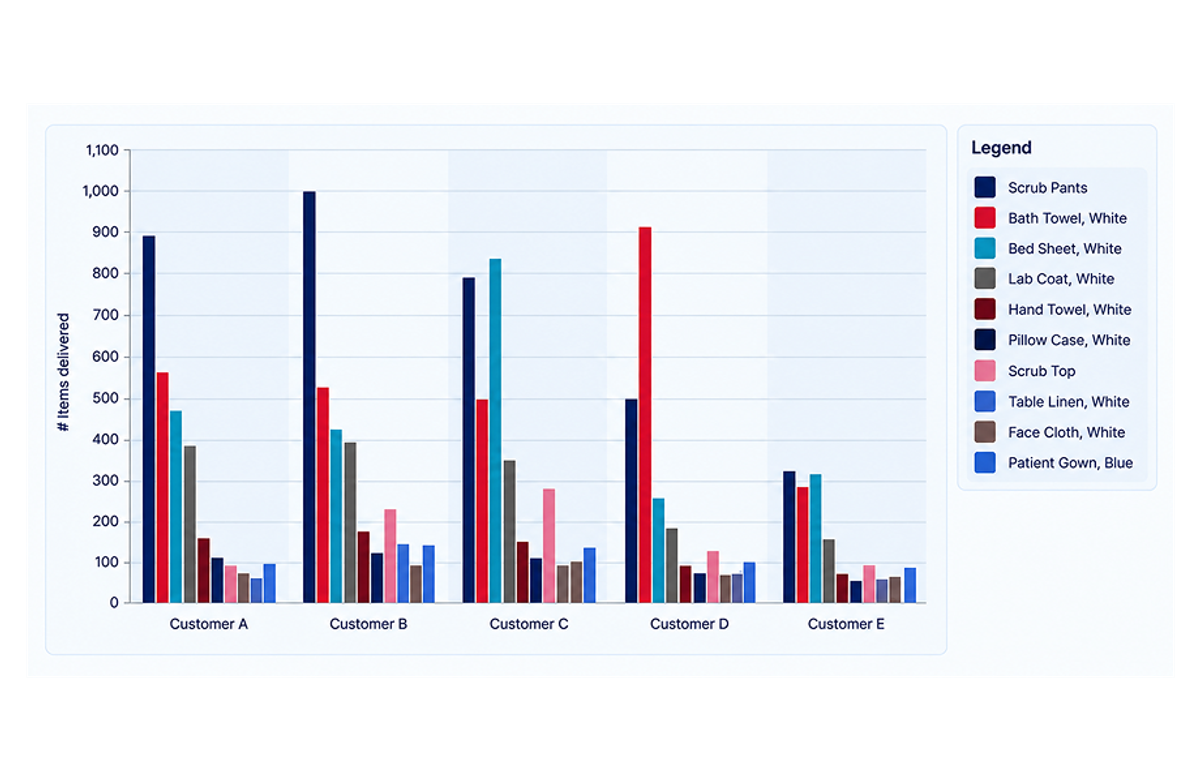
- The graph illustrates how the laundry can see how many items of each garment type are allocated to Customer A–E, creating a clear inventory profile for every account.
- Usage of the Information
- This allows the business to identify shortages, excess stock, and unusual inventory movements before they become operational problems.
- Instead of relying on manual counts, estimates, or outdated records, every tagged garment can be automatically identified and assigned to the correct customer.
d. Need for higher operational buffers
- Information provided by RFID
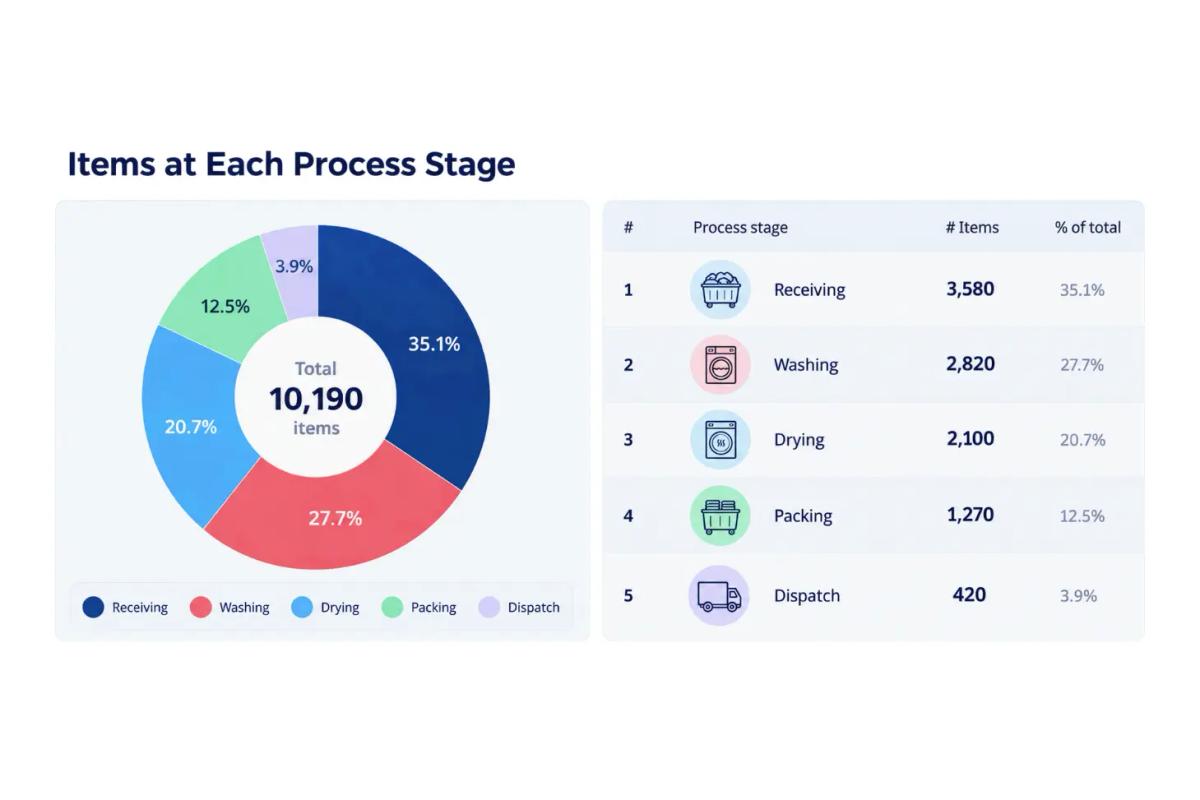
- RFID offers the laundry business a real-time overview of where its garment inventory is located within the laundry process.
- Instead of only knowing the total number of garments in circulation, the laundry can see how inventory is distributed across each operational stage.
- Usage of Information:
Operational buffers are often increased to compensate for uncertainty.
- Without RFID visibility, the laundry may not know exactly how many garments are at Receiving, Washing, Drying, Packing, with the customer, or ready for dispatch. To avoid running short, the business therefore keeps extra garments in circulation as a safety buffer.
- With RFID, the dashboard provides a much clearer picture of where existing inventory actually is and how much is available at each stage. This allows the laundry to distinguish between a genuine shortage and inventory that is simply somewhere else in the process.
- For example, if Customer A needs 1,000 garments, but only 700 appear available, the laundry might normally purchase another 300 as a buffer. RFID could reveal that 200 are being washed and 100 are already packed for dispatch. The business doesn't necessarily need more garments. It needs visibility of the garments it already has.
III. The Conclusion
Ultimately, RFID provides the Operations Manager with a data-driven view of the entire garment circulation process. Reliable information on inventory, garment movements, losses, and delays reduces the need for excessive operational buffers and reactive decision-making. Losses can be traced to their last known point, improving accountability, while process-level data helps identify recurring issues and enables targeted corrective actions. As a result, RFID shifts operations from uncertainty and reaction toward proactive, measurable, and efficient control.
Blog
 Blog
Related Blog

Operations
When RFID Isn't the Right Answer
Not every process needs more hardware. Here's how we decide when RFID is the right tool, when it isn't, and what we recommend instead.

Technology
RFID Tags by Leanwave
RFID stands for Radio Frequency Identification. In simple terms, RFID allows an object to be identified wirelessly using radio waves.

Technology
Introducing Leanwave
Leanwave delivers tailored RFID tags, hardware, and integrated software designed to optimise complex operations in commercial textiles, healthcare, and hospitality.