


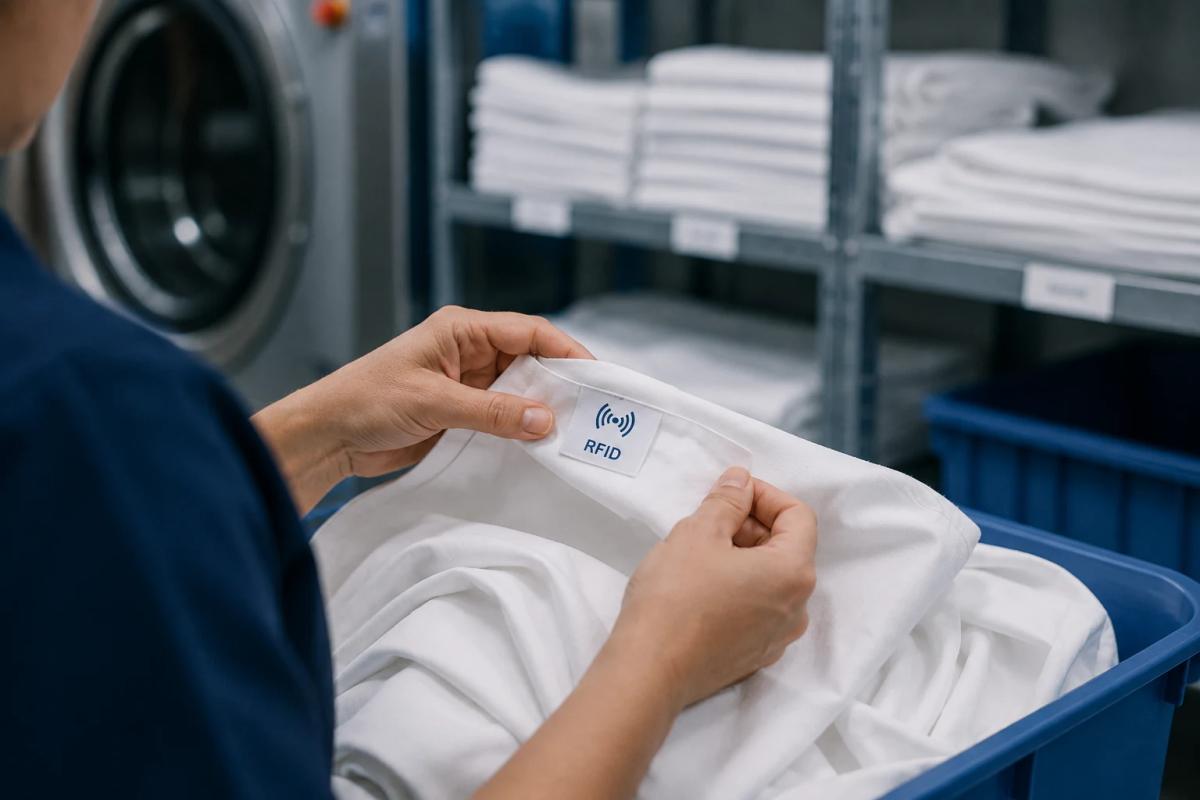
Technology
RFID Tags by Leanwave
What is UHF RFID?
RFID stands for Radio Frequency Identification. In simple terms, RFID allows an object to be identified wirelessly using radio waves.
A passive UHF RFID tag contains a small chip and antenna and does not require its own battery. An RFID reader sends radio-frequency energy through its antenna. The RFID tag uses energy from that signal to activate its chip and communicate its stored identification information back to the reader.
One of the major advantages compared with technologies such as barcodes is that RFID does not necessarily require direct line of sight, and multiple tagged items can be identified automatically and simultaneously, depending on the application and environment.
For textile service, this creates the potential to identify large quantities of garments or other textile products as they move through different stages of the process.
Main performance characteristics
High and long read range - The tag is designed to provide strong read performance and range, giving customers greater flexibility in designing RFID applications.
Strong proximity performance - Textile-service environments can involve large numbers of tagged products packed or positioned very closely together. The tag therefore needs to continue performing effectively in dense tag populations.
Production consistency - It’s not enough to have a few sample tags that perform extremely well. For large scale RFID deployments, customers need predictable and consistent performance across large quantities of tags and across production batches.
High performance within the textile environment - The focus isn’t simply laboratory performance. The specifications are designed around how the tag performs when it is actually integrated into textiles and used within the real-world textile-service environment.
Application options
- Heat-seal - for applications where the tag is attached using an appropriate heat-sealing process.
- Non-heat-seal / sew-in - a straightforward solution where the RFID tag can be sewn into the textile.
Chip options
There are also two different chip options. One uses a newer-generation chip and takes a more forward-looking approach toward future RFID applications. The second is a proven, robust and cost-efficient solution designed for applications where the fundamental requirements are more straightforward.
The goal is to give customers the right balance between: Performance + Consistency + Cost efficiency + Future-readiness.
“We’ve worked closely with one of the global leaders in the industry, and I also spent many years myself as an engineer and operations manager for a European textile-service provider. Through that experience, we developed a very clear idea of what an RFID tag needs to do in this environment”
Our philosophy: The tag you put into a textile today shouldn’t become the limitation of what you can do tomorrow
The question shouldn’t only be: “Will this tag work for what we’re doing today?” It should also be: “Will this tag support where we want to take RFID in the future?”
Similarly, today the customer might read products through a relatively small RFID doorway or gateway. In the future, the ambition might be to read and identify inventory automatically through antennas installed in the ceiling of a large warehouse.
The tag therefore needs to perform strongly in the current environment while also providing a foundation for future RFID applications.
Why would a business need RFID tags?
A lot of people initially evaluate an RFID tag only from the perspective of the immediate problem they are trying to solve. But when RFID is introduced into a business environment, it can create many additional opportunities that weren’t necessarily part of the original business case.
The potential development of RFID can be thought of as: Identification → Transparency → Understanding → Prediction → Action.
First, RFID identifies the item. Then it provides visibility into where the item is and how it moves. That information helps the company understand what’s actually happening within its processes. Over time, patterns in the data can help identify what’s likely to happen next. And ultimately, the business can act proactively rather than reactively.
The transparency you want
For textile-service providers, operational control begins with a simple question: Where is my inventory?
Because textiles function as circulating assets by moving continuously between laundry facilities and customer sites which is why maintaining full visibility is critical. RFID technology provides end-to-end tracking throughout this entire loop, helping businesses answer key operational questions:
- Dispatch & Return Tracking: What was sent, when it was delivered, and what has returned.
- Accountability: What is currently stored at the customer's site? And what has been lost?
- Loss Prevention: Where did missing inventory disappear? At the client facility? Or within internal handling?
By replacing manual tracking with RFID automation, service providers eliminate blind spots, protect their assets, and ensure accurate contract delivery at every stage of the cycle.
The transparency you need
Inward-looking
Once items can be identified at different stages, the same data can also provide information about production performance. For example:
- How long does an item remain at a particular process stage?
- Where are items accumulating?
- Where are the bottlenecks?
- How efficiently is inventory moving through production?
- Are particular process stages taking longer than expected?
An RFID project that starts as an inventory-transparency project can therefore become a tool for production and process optimisation.
Outward-looking
RFID can also open up a much better understanding of what’s happening at the customer. For example:
- Does the customer have more inventory than necessary?
- Is inventory continuously increasing?
- Is actual consumption higher or lower than expected?
- Is demand suddenly increasing?
- Is the customer approaching an inventory shortage?
This opens the possibility of moving from reactive service to proactive service.
How does this data transform your day-to-day operations?
Anticipating customer requirements
If RFID data shows that a customer is consuming products faster than normal, the textile-service provider may be able to recognise that the customer is approaching a shortage before the customer realises it themselves.
Instead of waiting for the customer to call and request an emergency delivery, the provider could potentially react proactively and arrange an express delivery. That creates a very different customer experience.
Reducing the need for excessive safety stock
Without good transparency, uncertainty is often compensated for by maintaining more inventory. If a business doesn’t know exactly what it has, where it is, when it will return, or where excess inventory exists, then additional safety stock can become the easiest way to protect the operation.
RFID provides the potential to reduce that uncertainty. If one customer suddenly requires additional stock, the business may be able to identify available inventory somewhere else in its network and reallocate or redirect that stock, rather than simply increasing inventory everywhere.
“Transparency reduces uncertainty, and when you reduce uncertainty, you don’t always have to compensate with more inventory.”
RFID means different things to different roles
- Operations: Greater process transparency and better understanding of bottlenecks and efficiency.
- Production: Better production planning and visibility of how inventory moves through individual process stages.
- Logistics: Better route, delivery and inventory planning. Inventory management: Greater understanding of what inventory exists, where it is and how quickly it is circulating.
- Customer service: Ability to recognise potential customer problems earlier and respond proactively. Sales / account management: Better understanding of customer usage and actual inventory requirements.
- Management: Greater transparency across the operation and better data for strategic and commercial decisions.
Conclusion
“You might start with a very simple question - ‘Where is my product?’ - but once you have that information throughout the entire process, you suddenly have data that can help improve production, logistics, inventory, customer service and ultimately the commercial model of the business.”
Blog
 Blog
BlogRelated Blog
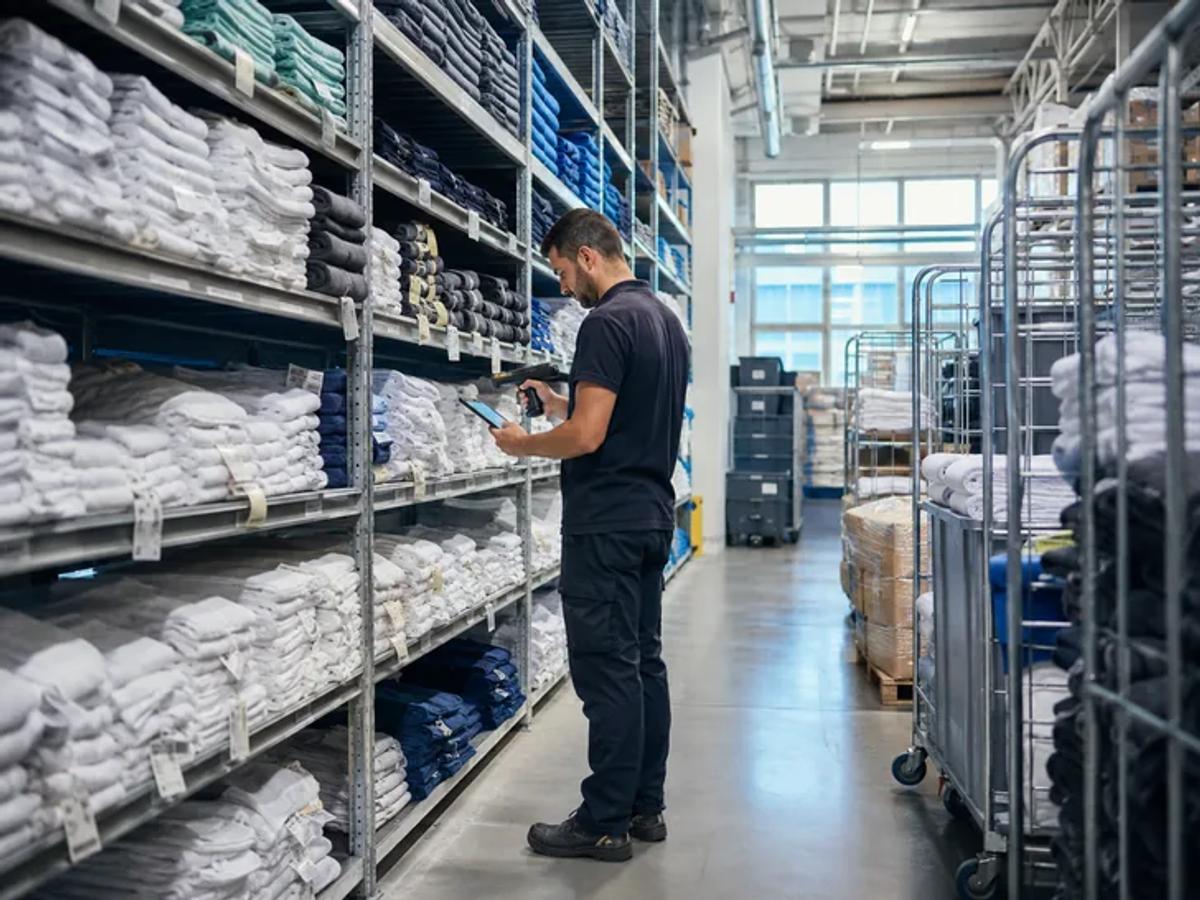
Operations
When RFID Isn't the Right Answer
Not every process needs more hardware. Here's how we decide when RFID is the right tool, when it isn't, and what we recommend instead.
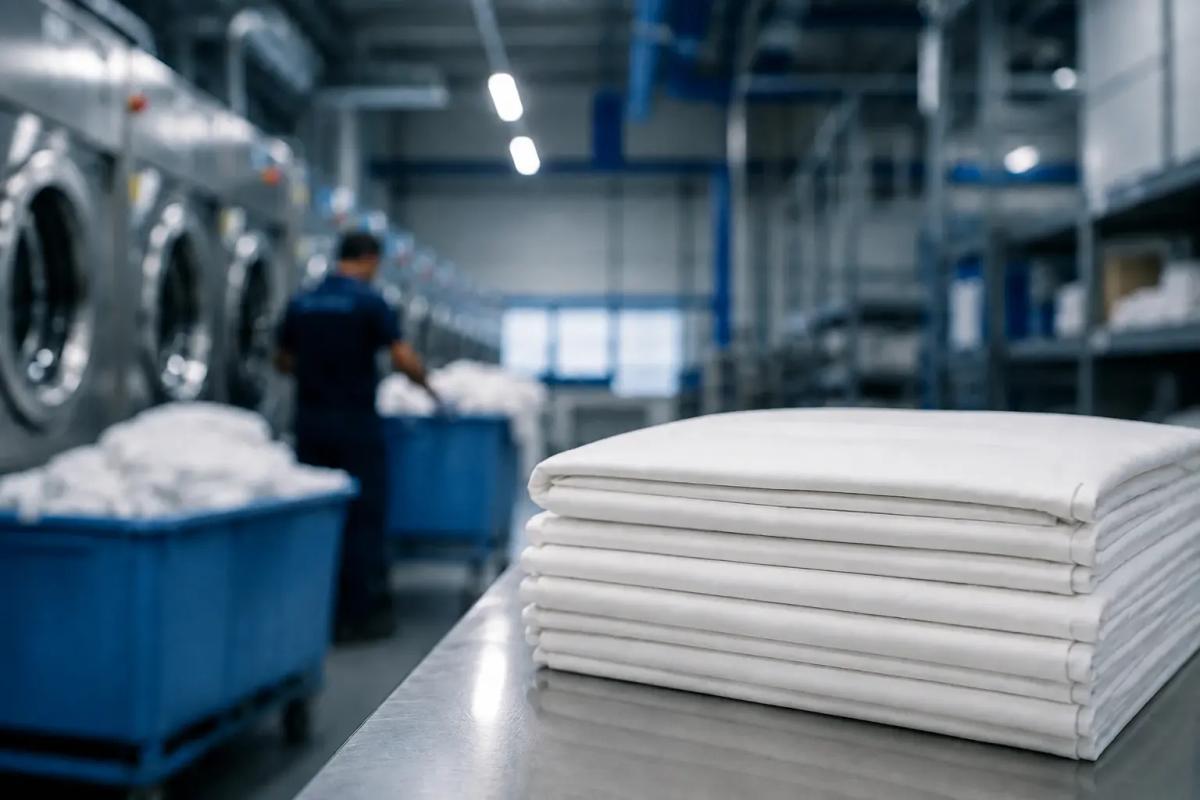
Technology
Introducing Leanwave
Leanwave delivers tailored RFID tags, hardware, and integrated software designed to optimise complex operations in commercial textiles, healthcare, and hospitality.